Why am I out here? Unlike Harris’s parents, who ran away to forget, I have followed to remember. You see, I killed Harris’s sister. It was an accident, but something for which I never took responsibility. But the mind does not absolve one who knows the truth. The soul grows sick from a wrong never made right.
Sunday, January 12, 2014
Penance by Sea - The Freighter
Why am I out here? Unlike Harris’s parents, who ran away to forget, I have followed to remember. You see, I killed Harris’s sister. It was an accident, but something for which I never took responsibility. But the mind does not absolve one who knows the truth. The soul grows sick from a wrong never made right.
Friday, October 18, 2013
The Winding Woods
It isn’t always straight forward, the way we find our way through the woods. It isn’t always by light of morning but sometimes by light of moon, when the owl’s hoot and silent wingspan fills dark spaces between the trees, and when eyes aglow follow our trail, quiet, waiting.
It isn’t always plain to see, the town that comes beyond the hill. The ramshackle huts with smoke drifting skyward, or the laundry drying on the dead brambles, or the twisted sheen of the madmen gathered near the well.
It isn’t always what we thought it would be, this love of the girl we travel to see, this milkmaid or seamstress or nursemaid’s scullion. At times she hides a blush behind her hand, while others she screams with pretty little fists that beat your chest, hollowed and tight like a drum. Then the stolen moments, fleeting for the memory to cup, and ugly moments that will never end and neither drink nor sleep will see it fade, and once she is gone there are all the moments that never were, but that we play upon and mould with hands now empty. Linger upon days that could have been, if we had found our way by different paths, for the woods know best, in their weathered bark and aged span of limbs, which is the path for me that day, and the next, and the next.
Sunday, November 09, 2008
Chloe Jean: Siren of the Skies
Chloe Jean. Even years later, just saying her name conjured the image of the young beauty buzzing low overhead, summer dress and scarf trailing in the wind. When he was thirteen, how many nights did he fantasize about sneaking off with her, taking to the skies, a stowaway in the cockpit between her thighs? He rode his bike to the landing strip at her father’s farm and hid away at the side of the hangar to watch her climb in or out of the cockpit, just in hope of catching a glimpse of leg or swelling breast beneath her summer dress. She was always smiling when she climbed in or out of the plane, the same kind of smile when a woman gazed into the eyes of a man she loved, but for Chloe Jean, it was reserved only for her plane.
He was in chemistry class when everyone heard the fire trucks and crowded by the window. A thin trail of black smoke curled into the sky over Peterson’s farm. Chloe Jean, the first love of his life, crashed and burned in a bean field. Investigators later determined that a tree limb at the border of the field had clipped her wing. For years afterward, boys from town kept a shrine in her memory at the trunk of the massive oak. He considered, several times, hanging himself from one of its limbs. He still feels, unreasonably, somehow less a man for not having done it.
Sunday, March 18, 2007
Safe Harbor
I’d left town to get away from a girl that ran the Tea House with her father. I left town to get my head straight, to find myself somewhere on the highways of the American southwest. Instead I just found dead coyotes and a bad case of hepatitis. I’d been delirious in a roadside hotel just outside of Tucsan. The owner’s mother took care of me there in room number 4. In my fever I was surrounded by demons, most of them looking too much like the father of the girl I was running from. But for the most part, fever deliriums are not what they’re made out to be. Most of the time I just felt frustrated, going round and round in my mind, circular arguments, clammy sheets, the knowledge that I was far from home and slipping into unconsciousness. But then my fever broke and I came out of it, like a boat emerging from a storm into safe harbor. Yeah, I see the parallels.
Okay, so maybe I did see elephants pirhouetting atop telephone poles, and scarecrows doing a mean tap dance down the rows of corn. Maybe I invented a new language from idiotic sounds, shuzzle de bop and de dim bam floozy. Maybe I did find myself in a foreign town of steep hills and nearly vertical streets. I boarded a trolley that laboriously climbed, climbed, climbed, until it reached the apex. What a view, in that split second before the descent. An old drunk drives the trolley, and he frequently drifts off to sleep, awakened only by the blaring car horns as we shoot through intersections against the red lights. He takes another shot from a bottle of rum. His ancestors were pirates, you know, and this infamous bloodline of criminals has diluted itself down to this pathetic figure driving a trolley. Before the trolley crashes through the docks at the edge of the harbor, I leap off while it’s still rolling.
I wander the fishing piers. Great bins of silvery pollock and mackerel, herring and sardine, jellyfish and squid. Mermen cart their catches around in crates, ye traitors of the sea. Where have all the Mermaids gone? Out there in the bay, flipping their glittery green tails in the morning light. Beautiful swelling hips cresting the waterline as they dive deep. I try to steal a rowboat to paddle out to them, to cavort there in the rippling blue water, but all of the boats are filled with pale bloated bodies, flies, and the stench of seaweed. I launch them all out into the bay to let them drift to their final destinations.
Where am I going with this? This is delirium. This is fever. This is like a runaway train that finally rolls to a stop in my home town. Stuttersville.
I leave the station platform and walk across town towards the girl I had been running from. It is in the early morning chill that I crept through wet grass towards the Tea House windows. Inside, a golden light burning from a single lamp in the library. Creeping up to closer, careful not to lean into the light pooling just outside the window, I looked to the two figures inside. The girl, still in her night dress, served up a pot of tea to her father crashed out on the sofa. He was drunk. She nursed him. She had a matronly kind of concern on her face for her father, brushing back a strand of sweaty hair off of his forehead. He wrapped an arm around her waist to pull her close. She peeled back his arm, like some kind of tentacle, and tucked it to his side, then crossed the room to the buffet where she set down the tea pot and wiped her eyes on her sleeve, and I froze there crouched at the window, fingertips held up to the glass.
Sunday, August 27, 2006
Fishing for Mermaids
He went to the living room, pulled a Kleenex out of the box and tried blowing his nose again. Noting came out. He felt dried up and like his nasal passages was a closed up house with milk rotting on the kitchen counter.
He grabbed his car keys of the table and headed out.
He drove fifteen minutes to Mainstreet and pulled up outside the 8th Street Grill. It wasn’t on 8th street any more; it had moved from 8th to Main about six years back, but the owner didn’t want to pay for new printing on the paper napkins. Inside, the noise of families and friends talking, the clink of dishes, the cash register printing out checks, the hiss of food from the kitchen. He grabbed a seat at the counter. The waitress, Doreen, had high arching eyebrows like the McDonalds golden arches. Can those be real, he wondered? They didn’t look drawn on. She took a pad of paper and held it, ready for his order. What did he want? What did he really want? He didn’t know but he couldn’t make her stand there forever so he asked for a blueberry muffin and a cup of coffee.
He’d forgotten about his daughter; she was still on the dock, and unsupervised. So what if she wore a Snoopy life vest, that wouldn’t save her from a kidnapper or a bear. He almost got out of his seat to drive back, but then realized it wouldn’t matter if he drove back. She wouldn’t be there anymore. She’d have been taken in by the mermaids of the lake by now, and she would be submerged in the deep pools while the mermaids decorated her with clam shells and long draping garlands of seaweed.
“So where’s the wife today?” the cook asked from over the counter, smirking to the dishwasher clearing trays.
Probably fucking that shoe salesman out at the mall. “I don’t know Sam, do I look like I gotta track her comings and goings all day?”
“Just a question,” Sam replied, wiping his hands on his apron and snatching another order from the carrosel. He ducked back into the kitchen and Doreen slid a cup of coffee on a saucer front of him. “You hafta pick out your own muffin at the counter.”
“What the hell for?”
“Because that’s the policy, and I am not one to go against policy; now it’s just a few feet away. You can handle that, now can’t you Clark?”
For fuck sake, why does everybody have to tell me what to do? But he walked over and spent considerable time examining the muffins to find just the right one. By the time he made it back to his seat, his coffee was cold. Have to put more sugar in it now. He shoveled sugar into his coffee, then dropped the spoon with a clatter onto the saucer. He took a grim satisfaction of how Doreen jumped at the sound.
He could have his own affair, he figured. Maybe that elementary school teacher of his daughter’s, or maybe the girl that worked the counter down at the feed mill. She was probably too young for him, but leaving his wife for someone far younger than her would be all the better.
What the hell do I care if she’s screwing around with someone, he wondered? It’s only because of what people might think, is all. When you get right down to, does it matter to me if she’s found someone else? If she was to keep seeing that guy and nobody would find out, I don’t think I’d give a rip. But I want something too. If she gets to have someone on the side, some taste of satisfaction, then I deserve that too, don’t I? It just doesn’t have to be an affair. The last thing I need right now is another woman, so what’s it going to be?
Yeah, what’s it going to be, he asked himself, taking a sip of cold coffee that was bitter and sweet and at the same time, then a bite of one perfect blueberry muffin. Have to tell Sam he really knows how to bake them. Maybe later, he decided, still sore about the insinuation about his wife.
A boat? Yeah, a boat. He’d wanted one ever since they bought the lake home but his wife had always said no. He could escape out on the water from sunrise to noon. What you fishing for, Clark? Mermaids. Quiet down now. You’re scaring them away.

Saturday, July 29, 2006
Killer Koi
It was an early morning in 1973 when my father lost his leg to a killer koi. He was wading the koi ponds of Mr. Ellison’s estate, famed breeder of championship koi, harbringer of designer breeding in that ancient though clandestine field of koi-anetics. My father was the head koi-handler, scattering specially formulated fish pellets into the water, wading among the water lilies when the following events unfolded.
The groundskeepers were setting the sprinklers and trimming the hedges that early fateful morning. According to witness testimony, the estate was alive with birdsong, a light breeze stirred the magnolias, when suddenly an eerie stillness settled over the grounds. One groundskeeper recalled looking up from his work to see my father wading obliviously through the sparkling pools, then look over his left shoulder in the moment before the attack.
The first strike was a single violent pull on his heal, bringing my father bolt upright, like the first tug on a fishing bobber. Then, a single moment of shock and disbelief, followed by a violent thrashing that lifted him off his feet and submerged him in the shallow pool.
The groundscrew cried out, dropping hedgeclippers and pruners to come running to the waters edge. In the roiling water the head groundskeeper recalls seeing the flash of gold, white and black of the killer koi, and the flailing arms of my father. The koi had spun in a twisting motion, like an alligator roll, twisting off my father’s leg at the knee. By reaching out across the water with the handle of a rake, the groundscrew were able to pull my father out of the bloodied water to the safety of shore.
Panic ensued. Ambulence sirens. Crime photographers. A special committee from the American Koi Society (AKS). Although I was only a child, I remember staying at my father’s side throughout the night in the hospital. Perhaps it was because my father knew those fish better than his own childen that he had foreseen one of them rising up to claim his leg someday. From his hospital bed, through the haze of painkillers and delirium I heard him cry out, “Diablo Wasabi! Diablo Wasabi!”
How could I forget the koi of which he spoke? He always paddled at the waters surface with his head and eyes peeking above the water line, watching me, unblinking, the school of fish giving him a wide burth. Have you ever seen the eyes of a koi? Black, lifeless eyes. A doll’s eyes.
Mr. Ellison posted a $10,000 reward to capture the killer koi. A mob converged on the ponds of the estate. Half of the school was obliterated, captured in nets, stunned by underwater explosives, snagged by children with Snoopy fishing poles, and yet Diablo Wasabi eluded them all. Among the crowds of fishermen, ichthyologists, and media hobbled my father, a crutch in one hand and a gaff in the other.
The crowds parted, forming a corrider towards pond. As my father went into the water, the head groundskeeper clutched me to his chest so I would not witness the fight, but I heard the slow even wading of my father suddenly broken with fierce splashing, gasps from the crowd, and then a wet thud on the ground. I turned to see Diablo Wasabi flopping on shore, the sun glinting off the wet scales of gold and black. How small he seemed on the grass, yanked from his element, gills laboring in the open air. My father sat on the grass ten yards away, the bloodied gaff still clutched in one hand while rubbing the stump of his leg with the other. We all watched the killer koi take his last breaths and felt the same dissatisfaction my father must have felt, the futility of one more dead fish, the emptiness of revenge.
Monday, December 26, 2005
This Time With Feeling
She got off the train in Fredericksburg, dragging her travel chest behind her on the platform. She let it drop after only a few yards and dabbed her lips with a handkerchief. A young man addressed her with a slight bow. She smiled behind her handkerchief and nodded. He picked up the travel chest and followed her through the depot to a waiting carriage.
Not bad, but what is she doing here? I can’t see her:
She wore an emerald green dress with lace cuffs and a tightened bodice. An exotic black hat perched on her head with peacock feathers and more lace. Deep wrinkles near her eyes, and a mouth with a sharp upturn at the corners that formed a perpetual smirk. None of us knew the color of her eyes; we found that most strange when discussing her later, but then, how often do we note the color of a person’s eyes besides those of our loved ones? Muriel was anything but loved; gossiped about, maybe. Certainly envied and begrudged and estranged, but certainly not loved. A few men had the ill-advised notion of courting her, but they were so peremptorily denied, like she was merely returning a bowl of cold soup to the kitchen with a wave of her hand, that the rest of us learned from their mistakes and kept our distance.
Okay, but why’s she hated? Where’s the atrocity, where’s the fatal flaw of character, the sullied underbelly of what’s really going on here?
She’d been married to a house builder in the neighboring town of Lux’Bourge. Her husband had gained modest wealth building homes for the land prospector, Mr. Griffin. She’d tasted just enough of the good life to covet more. She accompanied her husband to many of Mr. Griffin’s dinners, and through cunning and artifice she asserted her self to private invitations on his yacht or one of his many country homes. Mr. Griffin’s net worth was legendary amongst the townspeople’s talk at the local pub. Muriel soon disappeared into the lavish wealth provided for by Mr. Griffin.
She’d been shunned by the proper townsfolk ever since she’d left her husband. Did Muriel even notice, or care? Mr. Griffins expansive estates were like living on an island, sheltered from the chill of the outside world. Luxury was closer than love to Muriel’s heart. Trainloads of crates arrived from Turkey and France and England, antiques, clothing, jewelry for a queen.
What a bunch of bullshit. Listen to yourself, trying to sound like a writer. Tell it again, this time the plain and simple truth:
Muriel got of the train and stood by her travel chest, waiting for a gentleman to take it up for her. She wore a dress much too expensive for our town; it immediately embittered the townswomen against her, and intimidated the men to a degree where none were willing to approach her. Thompson’s boy finally helped her, but we all knew what kind of a fool he was. Though the women often talked of running her out of town, I think a part them enjoyed—in fact needed—someone to despise so thoroughly. You see, Muriel had been married to a proper man in a modest house; he was a builder. They’d had two boys. Then she gave up everything, even her two boys, to become the mistress of the wealthiest man in the county: Mr. Griffin. Now, for a man like Mr. Griffin, hardly anything was said about his character. His money held him on a level from which he could not be judged. But Muriel, she was of us, so she became fair game. And game she was. What kind of woman would give up her own children, just so she could wear new dresses from Paris and have furniture shipped all the way from Turkey?
If we were still in the habit of burning witches at the stake, Muriel would have been well-done by this time. But in this day and age we only crucified the guilty with gossip and a slow burning hatred. But as in all hatreds, there was a trace of envy, and it was that envy that brought ourselves down a notch. We put up with her. We bided our time. We acquired the habit of walking around town with stones in our pockets waiting for right moment, that hidden signal that ran like a murderous instinct through the town, for the moment that called for blood.
Saturday, December 03, 2005
Tea Story
I hold two dollars and seventeen cents of change inside my pants pocket, spoils from an afternoon of panhandling along the mall; why don’t I go inside for a cup of tea? I’ve been banned, that’s why, by that red faced, heartless tea merchant recently exeunt from the alley, stage left.
Okay, so I exposed myself from under the table to a couple of elderly ladies sitting at the table next to me. But that was months ago. Since then the voices have subsided, the roiling waves of my subconscious calmed to a smooth surface. But the merchant won’t let me back in for another couple of weeks. I guess I shouldn’t be too angry with him; he didn’t call the cops on me. He just tossed me out the back door to this alley, through the steel door, one way exit, no handles.
I remember going to his tea shop as a boy with my mother. She would wear a flowered dress, bring her crocheting in a large bag stuffed with motherly kinds of things; knitting needles and aspirin and throat lozenges and checkbooks, wadded up tissues used to wipe my nose. I’d get a cup of juice while my mother would get a two cup pot of dark English Breakfast, lightened with milk and sweetened with two teaspoons of sugar. She would break off small bites from her scone and feed them to me. The tea merchant was younger then, face not so red, hair thicker and body slimmer. He’d flirt with my mother, though she mostly discouraged conversation with the merchant. We were here to get away from men, I suppose, all of whom were mere reproductions from that single deplorable image of my father. At least deplorable to her standards. My standards had not yet been formed, but I knew something was not right with the man that lived in our house, whom my mother discouraged me from calling “dad”, instead referring to him by his first name always: Chester. Chester was not the head of the household. Chester was not her husband or my father. Chester was a boarder in the attic, sleeping on an old army cot.
What was so bad about Chester? Beside the outbursts of profanity, the nervous ticks that would fling dishes or silverware from table to floor? I don’t think the primary reason was his stink: he was afraid of water, afraid of drowning, which he did one day in three and a half inches of bathwater, an accident for which my mother was acquitted. What really bothered her I suppose were his poems, written with charcoal on the walls of our cellar. Poems she would whitewash away each Sunday morning, but which would appear again throughout the week; different poems, magnificent, brilliant, rare glimpses at the colorful expanses of Chester’s fractured mind. She was afraid of it, perhaps, angered that the emotions and beauty remained either locked in his mind or confined to the cellar. Or maybe she hated that Chester’s poems were better than hers. I remember her poems only faintly, as they were quite forgettable; I only remember the flowery bindings of the vanity presses, the booklets that took much of her money to have printed for herself and relatives, signed in sprawling loops and squiggles carefully practiced. My mother, lover of tea, offender of bad poetry, guilty of neglect and cruelty towards her Tourette’s ridden husband referred to not as sweetheart or father or husband, but only as Chester.
Sunday, November 27, 2005
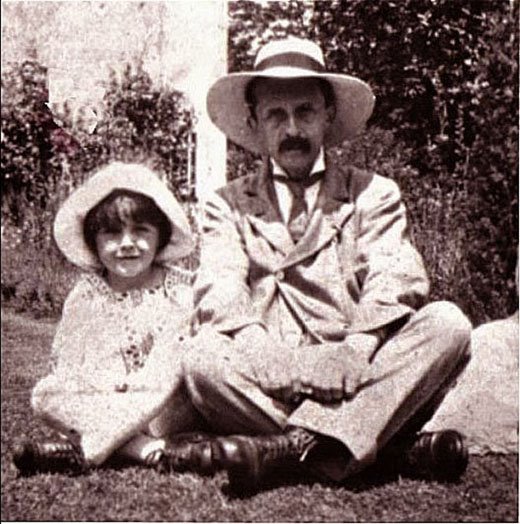
JM Barrie
Today I finished reading the biography “JM Barrie and the Lost Boys,” by Andrew Birkin. I think I’ve been reading it for about a year. It’s been an important and comforting book for me, one which I almost didn’t want to finish, and now that I have, perhaps can attributed to my melancholy mood all day.But what has it meant? Why have I connected with it?
Number one, I loved reading Peter Pan, and am in awe of its endurance as a story, its tradition, and the effect it has had on children over the years. Its theme is a powerful one in my life. I too feel like a child that either won’t grow up, or can’t grow up. I seek throughout my ordinary existence ways in which to escape to a magical world like Neverland. So naturally I was entranced with the man that created all of this.
I find in Barrie a similar soul, a man subject to dark moods but whose life is so quickly brightened in the presence of a child. Watching them play; “They’re so innocent, it almost hurts” (p253). There is a magic within a child’s mind, which we are much the poorer for having lost in adulthood. It is my struggle in life to regain a little of that spark. We need not grow up, if we don’t want to. But we are also sacrificing so very much if we choose to remain a child. Marriage, children of our own, and family are all lost. I tried marriage. So did Barrie. Neither of us had much success at it.
Although I’m drawing many parallels between Barrie and me, I don’t mean to say I enjoyed Birkin’s book because of these perceived parallels. I know I am no Barrie. I think I enjoyed it most because I felt like one of Barrie’s lost boys, and when I opened the book I was one of the lucky children that gathered around him and Porthos in Kensington Garden. It was less the spell of Peter Pan than that of “Uncle Jim”, cast decades later on a man who still feels like, and wants to remain, the child.So many dog-eared pages, I can jot down only a sampling of them here:
On the nature of children: “Unlike Ingley, Carroll and Wordsworth, Barrie rarely perceived children as trailing clouds of glory; he saw them as ‘gay and innocent and heartless’ creatures, inspired as much by the devil as by God. He exulted in their contradictions: their wayward appetites, their lack of morals, their conceit, their ingratitude, their cruelty, juxtaposed with gaiety, warmth, tenderness, and the sudden floods of emotion that come without warning and are as soon forgotten,” (p19).
On the actor Gerald du Maurier’s creation of Captain Hook, “Gerald was Hook; he was no dummy dressed from Simmons’ in a Clarkson wig, ranting and roaring about the stage, a grotesque figure whom the modern child finds a little comic. He was a tragic and rather ghastly creation who knew no peace, and whose soul was in torment; a dark shadow; a sinister dream; a bogey of fear who lives perpetually in the grey recesses of every small boy’s mind. All boys had their Hooks, as Barrie knew; he was the phantom who came by night and stole his way into their murky dream….And, because he had imagination and a spark of genius, Gerald made him alive,” (p110).
Two pictures of Barrie will remain with me; one, the melancholy older man who has felt “his boys” slip away from him in death or adulthood, the “Hermit of Adelphi, roosting high in his eyrie above the Thames” (p298). The other; of the magician of Kensington Gardens, creating along with five boys an inspired adventure, a fairytale bursting so suddenly into the world, like a cannon shot from the Jolly Roger.
Saturday, November 26, 2005
Readers Creepers
Northern fern photo by Ingus.
He saw her come out of the coffee shop, carrying a paper cup of coffee with a little cardboard insulator like a tube top. Her books always had characters drinking tea. Looked like she lied, but isn't that what novelists do? Just because her characters drink tea, did that mean she had to drink tea? Just because her characters engaged in clandestine affairs, did she? Maybe. He quickened his pace to catch up to her.
"Nicole? Nicole Lanser?”
She slowed her pace, looked sideways at him suspiciously. "Yes?"
"I'm reading your latest book. I thought I recognized you from the picture on the back."
"There wasn't a picture on that one."
"Oh yeah, that's right. I know where I recognized you from. It was that article in the Star Tribune about you."
"Oh yes. I liked that picture. There's not many pictures of me that I like, but the photographer on that day caught one of the few." She took a sip of coffee. "Can I help you with something?"
"Oh no," he said. "I just wanted to say hi. And that I like your book. There's some parts I'd like to talk with you about, though. Could I maybe buy you a cup of coffee or something?"
She stopped walking, smirked and held up her paper cup. "I kind of already have one."
"Oh yeah, of course. Well maybe we could--"
"I'm sorry, but I was really headed home." She winced, realizing her mistake.
"Maybe I could walk you home! You live around here? I mean, I know the article said you lived in South Minneapolis, but I didn't know we lived so close to each other."
"I'm not really comfortable with--"
"I knew Owen," he said, and started walking.
She followed to catch up. "Pardon?"
"I traveled around with Owen in '95. Just after you broke up."
"But nobody knew we were going out."
"I did." His brow furrowed, eyes staring hard into the sidewalk as he walked slowly ahead.
"How is he? Does he still write? I've been trying to find him on the internet, but..."
"I don't know how he is." His dark eyes suddenly brightened, and a big fake smile spread on his face. "But I didn't come here to talk about Owen. Got any tea in the house?"
Nicole noticed he turned at the correct corner towards her house. "Coffee?"
"I thought so." He walked to her house, Nicole in tow.
Nicole's living room was decorated as vividly as her books. Dark red walls, a pressed-tin ceiling painted black. Fern bursting green in a bright bay window. Dark wood molding. Shelves of books tattered and worn, bought not for ambience but for reading, tearing into with a writer’s eyes, from which to learn, emulate, pilfer. She handed him a steaming cup of black Columbian. He took a sip, then understood why she went out for coffee.
"Where's your Underwood? I thought you wrote in front of the bay window on an Underwood, at an antique school desk"
"I actually write on a Mac upstairs. Fabrication for the reporter. Sounds a lot more romantic."
"Sells more books."
"Exactly."
"Owen was writing while we traveled. I did the driving most of the time. He wrote in a notepad. First it was love poems. There's nothing I hate more than unrequited love poems. Then we got into Mississippi, Tennessee, Louisiana. Drove mostly at night. Slept in the car in parking lots during the day."
“Why drive only at night?” she asked.
“Owen didn’t like traveling during the day. He wouldn’t say why. It was like he didn’t want to be recognized, like he was running away from something.”
“From me.”
“Probably.” He set the horrid cup of coffee on the end table and got up, browsed through the room, reading book titles, looking at artwork and photographs hanging on the walls, but really wondering what corner of the house he would find her bedroom.
“What are you laughing at?” she asked.
“Nothing,” he replied. He already knew where it was. Just like he knew what city to find her in, just like he new where she lived, just like he knew where she could find Owen, and it wouldn’t be on the internet.