Lie #2, invented as an answer for other vacationers in Puerto Vallarta curious about why I’m traveling alone: “Actually, I’m working for Lu___t Technology in a think tank about twenty miles between here and Guadalajara. I’m in the R&D department, and we’re working on a cutting edge new technology, but it’s highly classified, I shouldn’t be talking about it.”
They buy me my first drink.
“Well actually the classified part is more on how the technology works and the materials we use, rather than the concept. We’re working on an Identity Chip, which is a tiny chip placed under the skin on your wrist. This is prototype 4A…” I show them a tiny gray rectangle viewable just beneath the skin on my wrist, actually the lead tip from a #2 pencil stuck in me since the 5th grade. “It can store your driver’s license, your credit cards. So when you’re in a store, you just scan your wrist and your items are paid for. No signatures, no losing your card…Yeah, you’re absolutely right. The fear of having your personal information stolen or forged is our biggest hurdle with this product. That’s really where the majority of research is being done right now: how to secure your information, and control who gets what information. But that’s also the details I can’t talk about.”
They buy me my second drink.
“The chip interacts with your body’s unique chemical make-up, so if it detects a foreign chemical makeup, the chip is disabled. And it’s that biological link that interests me. We’re working on having it tell you when you have a fever, when your body is fighting a virus, possibly even test your cholesterol. It will store your complete medical and dental record. Another concept that’s generating a lot of interest is similar to Bluetooth. You can set up your own profile in your identity chip, with your interests, where you’re from, if you’re single and looking, even your picture, so when you walk into a bar with a receiver, it will tell you who else is in the bar, ‘Oh look, someone else here is from Minnesota, or there’s a Packer fan, let’s buy him some Cheese curds, or there’s a single woman who’s favorite movie is “The Cable Guy” just like me. When do we think this product is going to hit the market? I can’t talk about that.’
They buy me my third and last drink.
“We’re in a race with our sister think tanks in Paris and Sunnyvale California, all working on different aspects of the Identity Chip. The codename for our think tank is ‘Tortilla Chips’. The one in Paris is ‘French Fry’ (they don’t have chips there), and the one in California is ‘Highway Patrol’. I know, it kind of evolved into that. It started out as CHiPs, like the TV show with the motorcycles. Then we just called them ‘Motorcycle Boys’ because all the guys rode motorcycles to work to be like Pancho. Then a woman joined their team, so it was ‘Motorcycle Boys and a Girl’. Then another woman joined and it just became ‘Highway Patrol’.
“Well I better head on out. It’s been fun. Please don’t share this information with anyone.” They take one more look at the piece of lead in my wrist. “Yeah, technology just keeps getting smaller and smaller. Thanks for the drinks. Please please keep this information to yourselves, and Buenos Noches.”
Thursday, April 13, 2006


Tuesday, April 11, 2006
Lie #1: Wife Kidnaps Iguana

First night in the hotel restaurant in Puerto Vallarta, I take a table by myself. As eyes stray over to my table, I begin to invent my persona. Or maybe, at this point it is more of an erasure of who I have been and who I invent myself to be. I’m now prepared for the next time someone asks me, “So what brings you down to Mexico all by yourself?” Sure enough, within minutes I have my first bite.
“I’m here looking for my wife. She emptied out our bank accounts and ran off with her yoga instructure. He’s originally from Puerto Vallarta. A credit card transaction showed they’d been down here.”
“That’s terrible,” the woman from Arizona says, her face a mask of concern and sympathy. “How are you ever going to find her?”
“I’m not sure, I’ve left flyers at several clubs and yoga studios. My biggest concern is for Lui.”
A sharp intake of breath from the woman, “Your son?”
“No, my pet iguana. I’ve had him for fifteen years.” Choking up, “I mean, she can have the money, that doesn’t matter…but what can she want with my iguana?”
Her husband offers tentatively, “Well, Puerto Vallarta is a natural habitat for iguanas.” I heard a bump under the table and he pursed his lips.
The woman behind the lobby counter was waving towards me. I rose from my chair and lay the napkin on my seat. “Exuse me, just a moment.”
I crossed to the lobby desk where the hotel employee greeted me. “Ola, Senior Wood. Your housekeeper has changed your bed linen. I am so sorry it smelled of smoke. It is a nonsmoking room.”
“Thank you so much.” Feeling the Arizona couple watching me, I reach across the counter and shook her hand vigorously. “Thank you! Gracias! Gracias! Please have a crème brule sent to my room.”
I strode back to my table, the Arizona couple’s expectant faces turned to me. While scrawling my room number on my bill, I said, “They’ve spotted her. They spotted her down at the Happy Frog! I’ve got to go…” As I marched off I heard from behind me the plaintive voice of the woman from Arizona, “Good Luck!”
I walked quickly through the lobby, down the steps to the taxi turnaround, said “Buenos Noches” to the doormen, then slowed my pace as I rounded to the side stairwell, climbed to my fourth floor room, and watched a Mexican soccer match on the television while I used a spoon to tap through the melted sugar crust of my crème brule.
Tuesday, March 28, 2006
A Writer's Struggle
Let’s assume now, for a moment, that I will be able to focus my energies enough this evening to sit down and write. I have blocked off the evening, eaten dinner, avoided any stimulants of alcohol or medication so as to clear my head. The laptop now sits upon my desk, rather than on the Ouija board on the ottoman by the leather chair. This is serious.
[5 minutes later] Presently, I am cooking a butternut squash, on the recommendation from John Felling. The shepherd’s pie was not filling enough. After I eat that, and brew my tea, and tidy the apartment for it is simply an external reflection of my state of mind, I will begin to write in Stuttersville. Don’t be intimidated that Edgar is approaching the house of his uncle, and that you do not yet know how to handle the potential secrets to be uncovered there. It will all flow naturally once you fill Edgar’s shoes and begin to roam the house. You’ve seen it now, that Germanic village house atop the hill, circled by pines. Not a mansion by any means, but the home of a wealthy bachelor, with a sense of taste, not lavishness.
What time of year is it in Stuttersville, right now? Are there gardens out back, or the skeletal trees and trimmed back flowerbeds, the covered rosebushes. Yes, it must be fall. Pre-halloween? Oh shit, I don’t know.
[15 minutes later] I still believe that writing may be possible this evening, especially if I toss aside any pretensions of publishing it some day. This way I lessen the pressure of getting it right. Don’t forget that Stuttersville is intended to be a sandbox, a place in which I can retreat, and think and feel and narrate anything, even my own trouble as the writer trying to wrench it free from obstacles. Ready…set…go!
He spent nearly a decade chasing down the facts of his uncle’s death. What became of the doctor that had signed his death certificate? Why had the authorities shot down family requests for an autopsy?
For more years than family historians could trace, there had been deep rifts within the family. Not as simple as a sudden branching out of the family over the disagreement of two brothers. It seemed to be a genetic flaw that cast the members of this family against itself for generations. It thrived on conflict. Each member contained within themselves a voilent urge to scratch out the eyes of their brother. Others grew inseparable, every secret shared, lives entwined, homes no more than blocks apart, or children living with their parents well into their forties.
[10 minutes later] Okay writer, you’re struggling…the light is starting to fade….run ahead to catch up with it!
With the increasing years of decrepitude, one boy rose up out of the poverty in which his family had fated him. His boyish exuberance had caught the attention of labor owners, of warehouse stockmen, of dockworker supervisors. He didn’t have any brains, they knew, but he would give 100% of himself to slave away at a task, and all he looked for in return was a little beer money.
[10 minutes later] Crap, it’s all falling apart now. You see it, don’t you? The narrator has grown sleepy and his rationality has taken to drink. A glass of port sits beside me, a treat for having sat at my desk in the den throughout the evening, in the similitude of writing, even if the words were wasted on the wrong story.

[5 minutes later] Presently, I am cooking a butternut squash, on the recommendation from John Felling. The shepherd’s pie was not filling enough. After I eat that, and brew my tea, and tidy the apartment for it is simply an external reflection of my state of mind, I will begin to write in Stuttersville. Don’t be intimidated that Edgar is approaching the house of his uncle, and that you do not yet know how to handle the potential secrets to be uncovered there. It will all flow naturally once you fill Edgar’s shoes and begin to roam the house. You’ve seen it now, that Germanic village house atop the hill, circled by pines. Not a mansion by any means, but the home of a wealthy bachelor, with a sense of taste, not lavishness.
What time of year is it in Stuttersville, right now? Are there gardens out back, or the skeletal trees and trimmed back flowerbeds, the covered rosebushes. Yes, it must be fall. Pre-halloween? Oh shit, I don’t know.
[15 minutes later] I still believe that writing may be possible this evening, especially if I toss aside any pretensions of publishing it some day. This way I lessen the pressure of getting it right. Don’t forget that Stuttersville is intended to be a sandbox, a place in which I can retreat, and think and feel and narrate anything, even my own trouble as the writer trying to wrench it free from obstacles. Ready…set…go!
He spent nearly a decade chasing down the facts of his uncle’s death. What became of the doctor that had signed his death certificate? Why had the authorities shot down family requests for an autopsy?
For more years than family historians could trace, there had been deep rifts within the family. Not as simple as a sudden branching out of the family over the disagreement of two brothers. It seemed to be a genetic flaw that cast the members of this family against itself for generations. It thrived on conflict. Each member contained within themselves a voilent urge to scratch out the eyes of their brother. Others grew inseparable, every secret shared, lives entwined, homes no more than blocks apart, or children living with their parents well into their forties.
[10 minutes later] Okay writer, you’re struggling…the light is starting to fade….run ahead to catch up with it!
With the increasing years of decrepitude, one boy rose up out of the poverty in which his family had fated him. His boyish exuberance had caught the attention of labor owners, of warehouse stockmen, of dockworker supervisors. He didn’t have any brains, they knew, but he would give 100% of himself to slave away at a task, and all he looked for in return was a little beer money.
[10 minutes later] Crap, it’s all falling apart now. You see it, don’t you? The narrator has grown sleepy and his rationality has taken to drink. A glass of port sits beside me, a treat for having sat at my desk in the den throughout the evening, in the similitude of writing, even if the words were wasted on the wrong story.
Sunday, March 26, 2006
Boot up, Tune in, Log Off
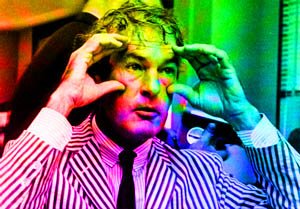
Whew, I finally dragged myself off the internet, and it feels like I can breathe again. Why do I get so obsessed with things, like browsing the internet, reading movie scripts, browsing Flickr photos, reading blogs of friends, rereading my blogs? Can I say blog one more time?
I come to my big leather chair by the window and my laptop resting on the Ouija board with the idea that I’m going to write. But I look out the window and stare over the dead gray city and realize I don’t want to write at all. I have nothing to say this morning. I can’t imagine pulling two characters together and figuring out what they have to say to one another. But I will not give up. I’ll just keep typing here, right? Isn’t that the important part of the word “Stream-of-Consciousness Journal?”
When I move about the apartment in the evenings, I am filled with ideas. Wonderful turns of phrases, situations of intriguing conflict, a desire to slip into an imagined world for a little while, but I’ve got to put the dishes away. I’ve got to sort the real mail from the junkmail. I’ve got to brush my teeth and go to bed.
I remember some of the ideas now, but they lay limp in my hands like dead fish I’ve held out of the water for too long. It’s like that Tenacious D song “Tribute”: “This is not the greatest song in the world. It’s just a tribute…to the greatest song in the world”. Things like a comic entry about how I keep piling the recyclables on top of each other in the grocery bag in the closet. It becomes like a reverse version of Jenga, and I come up with strategies of how to nest cans within one another, then a bottle, then an upside down can clinging to the bottle neck. Anything to avoid having to take the recyclables down to the bins in the parking garage. Like I said, this is just a tribute.
Or the entry about how I’ve got a crush on the surly Latino woman at the Turtle Bread store. I love her smoldering eyes, not an ounce of fake cheer or sense of customer service. She’s young, short, plump like a loaf of bread just beginning to rise (I’m sure she’d love that simile... and you wonder why I’m single!) When I get a flicker of a smile from her it is appreciated so much more, a small crack in her shell. But then it’s gone again, and I realize I don’t want her to smile at me, because I love her for this crossness and “piss and vinegar”. My god, is that a real phrase?
I wanted to start a blog titled “Squidup!”, or use that as a chat name. It’s from the Cable Guy movie when the Cable Guy is doing his Dizzy Gillespie impression.
I wanted to write about my tour of the condos and lofts, and why do I always get a crush on the sales women showing me a place? I feel this odd flirtatiousness or connection with her as we walk quietly through the empty rooms. I’m sure I’m imagining it, but I feel like they too are aware of this sexual tension between us.
Ah, see; I’m tempted to log onto the internet again. Restlessness draws me there. I thought for a moment that I would like to work more on my personal home page rather than my blog. It’s like wanting to work on your home, build it out, make it more presentable. Your own little space on the web, gardening for people without a plot of land, but I would probably be a better person if I disabled my modem. Somewhere Timothy Leary is chanting “Boot up, Tune in, Log Off.”
Thursday, March 23, 2006
Proclamation of Decadence
Submit to your addictions, your weaknesses, your every libidinous urge! Let the devil run rampant through your homes, your government offices and citadels! We have held ourselves in check long enough. It is the time to celebrate the body, the instinct, the animal pantheon spelled out in constellations across the night sky. We drag out our dictionaries of the profane and illustrations of decadence. We make new national holidays of crime and atrocity. We teach our children the balance of the blade, the angle of the wrist when snapping a whip across the buttocks of their nannies. Turn out all of the animals from our zoos, release mice into the backstage dressing rooms of the opera houses. Mayhem, licentious laughter, sinister smiles on lips beaded with blood. Rub your palms together, feel the tingling in every limb, cry out your allegiance to the celebration of the unholy.

Tuesday, March 21, 2006
Love Note

The cynic in me says "Someone's going to get laid tonight". The romantic says "Why didn't I think of that?" The analyst says "look at how he measured off areas of the lawn first, to be sure all of the letters fit right. That guy could design crop circles."
Sunday, March 19, 2006
Why?
I was in my favorite tea shop, eavesdropping on a conversation between addle-brained Christian Fundamentalists about experiments being done on prisoners in Duluth in which a machine fixes their “mental problems” when I noticed that the tea shop manager, Lisa, was standing just at the periphery of my vision. I realized she had asked me a question.
“I’m sorry?”
“So why are you going to Mexico?”
It seemed a very odd question to me. Why was I going to Mexico? I didn’t know that I needed a reason, but evidently I did, and couldn’t think of one. “I wanted to use my frequent flyer miles and Marriott points.”
It wasn’t until twenty minutes later that I realized all that was expected of me was the answer “To relax.” But during that twenty minutes, I was perplexed with the question: Why am I going to Mexico? Why Puerto Vallarta? Chaos and chance; it was merely an alignment of the stars, or more accurately, an alignment of available dates for frequent flyer miles and hotel points. But why go on a vacation at all? I was dumbfounded by the brilliancy of her question, as simple as a child’s: Why?
I sipped the dregs of my tea and looked at the shocking beauty outside: a spring day in Minneapolis, bright sun, melting snow. A pair of Canadian Geese came flying in low over the city, wing tip to wing tip. I craned my neck to watch them pass overhead, bottomless blue parted by a pair of geese cutting across the sky.
Beside me, a little boy sat at a table with his grandmother. He ate a giant M&M cookie, crumbs on those pale cream cheeks, grandma smiling down on him. He bounced in his chair, enthralled with his cookie and the bustle of the tea shop. I want the same kind of thrill out of life, but I am no longer satisfied by a cookie. Maybe that is a better answer for why I am going to Mexico. Because cookies just don’t cut it anymore.

“I’m sorry?”
“So why are you going to Mexico?”
It seemed a very odd question to me. Why was I going to Mexico? I didn’t know that I needed a reason, but evidently I did, and couldn’t think of one. “I wanted to use my frequent flyer miles and Marriott points.”
It wasn’t until twenty minutes later that I realized all that was expected of me was the answer “To relax.” But during that twenty minutes, I was perplexed with the question: Why am I going to Mexico? Why Puerto Vallarta? Chaos and chance; it was merely an alignment of the stars, or more accurately, an alignment of available dates for frequent flyer miles and hotel points. But why go on a vacation at all? I was dumbfounded by the brilliancy of her question, as simple as a child’s: Why?
I sipped the dregs of my tea and looked at the shocking beauty outside: a spring day in Minneapolis, bright sun, melting snow. A pair of Canadian Geese came flying in low over the city, wing tip to wing tip. I craned my neck to watch them pass overhead, bottomless blue parted by a pair of geese cutting across the sky.
Beside me, a little boy sat at a table with his grandmother. He ate a giant M&M cookie, crumbs on those pale cream cheeks, grandma smiling down on him. He bounced in his chair, enthralled with his cookie and the bustle of the tea shop. I want the same kind of thrill out of life, but I am no longer satisfied by a cookie. Maybe that is a better answer for why I am going to Mexico. Because cookies just don’t cut it anymore.
Thursday, March 16, 2006
Bound for Mexico

Ah, sweet relief. I'm off to Mexico for six days at the end of March, courtesy of my frequent flyer miles and Marriott reward points (thank you BMG and Nextel for those long-distance projects back in 2000). I'm staying at the CasaMagna Martiott Puerto Vallarta Resort. I've never vacationed alone, but I'm looking forward to it. Now...do I want to plan a bunch of outings, or sit on the beach with a margarita and Fitzgerald's "Tender is the Night".
Thursday, March 09, 2006
NyQuil for the Soul
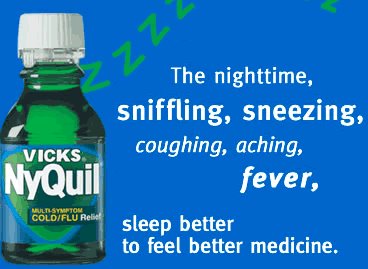
My teeth are stained green from the cold medicine that I drink. My mouth curls at the sickeningly sweet syrup, the caustic bite of the liquor, and then the more subtle strains of narcotic laced in this bright green concoction. Why do they make it so green, I wonder? I’ve also seen it come in bright blue. Perhaps so that once the narcotic starts to take affect, you peer at the bottle in the medicine chest, at its magical color, and you’re tempted to take another drink, as though sipping the sky.
My body has convinced itself that it needs medicine to be healthy. Or rather, the moment that my bloodstream has worked itself clean of any medicine, germs and viruses quickly descend and take over my body. And so I desperately tip back another shot of it, curl my mouth, wince with tears in my eyes, but instantly, beyond all physical possibility or reason, I experience relief pass through my gut to my limbs, my lungs, my mind. Everyone needs this, I think. A cure, a medicinal relief from that which ails us.
Sunday, March 05, 2006
The Whale, Inc.
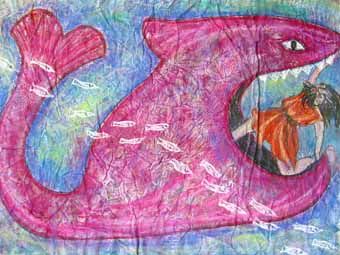
Jonah was swallowed by a large corporation and took refuge in its belly. He waited to see in what part of the world the great whale would spit him up, if ever. He lit fires in the belly and made shadow puppets on the walls of the stomach, while he waited. And waited. He would have completely forgotten what the outside world was like if not for the items the whale swallowed from time to time; a bicycle, a kite, a high school marching band, sometimes an outside consultant with tales of what life was like in other whales. Jonah wondered if life was better in another belly, if the perks were slightly better or the pay. And yet he always felt gratitude to the whale when, with a great upheaval and expurgation, it would expel from its gullet everyone it had collected over time, including the consultants, while he remained. Gone were those who were nearing retirement, those deemed redundant, those less emphatic about the greatness of the whale.
Jonah fumbled around in the dark for a time until he had gathered enough materials to light a little fire again. New people came splashing in the next day; young professionals fresh out of college, wiping water out of their eyes and trying to get their bearings. Their clothes were nicer than his, he noticed; silk ties and Kenneth Cole shoes and sweater vests, but he knew that given a few weeks in the digestive juices of the whale, they would look as disheveled as himself. And they did. With a trapped look in their eyes, some of them started searching the linings of the belly for ways to get out. They irritated the whale just enough so that they were either spit out or forced further down its digestive tract. Not Jonah. Maybe he was clever for having learned how to ride the corporation for all it was worth. Maybe he should have been ashamed with himself for having lost so much of his self respect and identity that he found himself content with life in the belly of the whale; but there it was, printed on all of his business cards, his stationary, even on the logos of his clothes: The Whale, Inc. Sometimes it felt safe to be so utterly consumed.
Thursday, February 23, 2006
Gone Fishing
Obviously I've been away from blogging for a while. The new job at work has been hectic and has supplanted my morning ritual of writing. Each morning I have to log into our servers, run a query to extract data, and email out the results. We've moved to a new building. Our area is in a reorg and everyone has to reapply for their jobs (I can keep my contract through the end of the year, though, or take a position as an employee). While everything has been turned on its head, I haven't been in the right mental state for writing. Don't get me wrong; it's an exciting time at work and I'm enjoying it, but it's exhausting.
So I'm taking a break until, hopefully, early March. I should really take a vacation then. I'm thinking Mexico. I've never been. Where is there a nice quiet spot on the ocean?
So I'm taking a break until, hopefully, early March. I should really take a vacation then. I'm thinking Mexico. I've never been. Where is there a nice quiet spot on the ocean?
Tuesday, February 07, 2006
Plant People
I wonder how long plants live. Do they ever die of old age, or always neglect or bugs? I have had the crawly strong plant (I never know real plant names) for almost twenty years. For stretches of time I forget to water it and it collapses in its pot like a deflated tire tube, but then I’ll cut it back to crew-cut length, and water it a couple times, and it bursts back to life like a woman out of a cake. If I was to nurture the plant, properly supply nutrients and fresh soil when needed, how long would it live? Could it outlast me?
Why do I love to surround myself with things that live a long time? I get a certain kind of comfort over having a plant or a pet turtle that has been with me over a dozen years, and I know will stay with me for a dozen more. It fights off loneliness, and I feel like they are the few creatures that realy get to know me. I am a constant figurehead, as they are for me. They have truly taken the vow to stay at my side through sickness and in health, if only due to confinement or a lack of legs with which to walk away.
Does anybody out there enjoy killing plants, getting some sort of pleasure out of slowly watching them die, or even torturing them, in a sense; feeding drops of saltwater or rubbing alcohol into their soil, lacerating their tendrils, possibly even slowly chewing on leaves? Do they imagine an unheard plea for mercy or cry of pain? You know this dementia has to be in the diagnostic book of psychology, and that Phizer has come out with a prescription to treat it.
There are two kinds of people out there; those with plants, and those without. Those with plants can’t live without them; they feel suffocated without a bit of greenery around them. Even at the office they need an ivy crawling down from their cabinets. Those without plants can’t tolerate them. The thought of taking care of it exhausts them; their houses contain maybe only a silk or plastic plant covered with dust behind a sofa. If you give them a plant, they will hate you for it and will watch it with a kind of fatalism as it dies. “See, I can’t keep a plant alive,” they say, not even attempting to water it, and it goes into the garbage with a certain satisfaction.
I am a plant person. I don’t know the names of them, I don’t talk to them, and I rarely dust off their leaves, but I notice when new growth appears. I look on them with pride when I see a flower bud appear.
I’ve got to get out of the house more.

Why do I love to surround myself with things that live a long time? I get a certain kind of comfort over having a plant or a pet turtle that has been with me over a dozen years, and I know will stay with me for a dozen more. It fights off loneliness, and I feel like they are the few creatures that realy get to know me. I am a constant figurehead, as they are for me. They have truly taken the vow to stay at my side through sickness and in health, if only due to confinement or a lack of legs with which to walk away.
Does anybody out there enjoy killing plants, getting some sort of pleasure out of slowly watching them die, or even torturing them, in a sense; feeding drops of saltwater or rubbing alcohol into their soil, lacerating their tendrils, possibly even slowly chewing on leaves? Do they imagine an unheard plea for mercy or cry of pain? You know this dementia has to be in the diagnostic book of psychology, and that Phizer has come out with a prescription to treat it.
There are two kinds of people out there; those with plants, and those without. Those with plants can’t live without them; they feel suffocated without a bit of greenery around them. Even at the office they need an ivy crawling down from their cabinets. Those without plants can’t tolerate them. The thought of taking care of it exhausts them; their houses contain maybe only a silk or plastic plant covered with dust behind a sofa. If you give them a plant, they will hate you for it and will watch it with a kind of fatalism as it dies. “See, I can’t keep a plant alive,” they say, not even attempting to water it, and it goes into the garbage with a certain satisfaction.
I am a plant person. I don’t know the names of them, I don’t talk to them, and I rarely dust off their leaves, but I notice when new growth appears. I look on them with pride when I see a flower bud appear.
I’ve got to get out of the house more.
Thursday, February 02, 2006
The Limb
Last night I slept wrong on my arm. I woke up in the middle of the night with this aching pain running down the length of my arm: it had fallen asleep. I tried to move it, but it wouldn’t budge. With my other hand I searched around for it, becoming frightened that it was so dead that it wasn’t lying where I thought it was. Then my fingers came in contact with my forearm. It was cold and lifeless, like a slab of meat. Images came to mind of “The Godfather” and the movie producer that awoke in the morning to find the severed head of his horse under the covers. With my left hand I lifted my right arm and set it down in a position in which blood could start flowing again. I cannot describe the agony of the next several minutes, like when a frostbitten foot begins to warm up again.
Why do I have such trouble with my limbs?
Many people sleepwalk. Several years ago I had a similar condition, only with an unusual twist; only certain limbs would become animated while the rest of me slept. One night I awoke to see at the corner of my vision a clawed hand hovering just above my head. It was my right arm, sticking straight up in the air, my hand reaching down as though to smother me.
I screamed, and the arm collapsed at my side.

Why do I have such trouble with my limbs?
Many people sleepwalk. Several years ago I had a similar condition, only with an unusual twist; only certain limbs would become animated while the rest of me slept. One night I awoke to see at the corner of my vision a clawed hand hovering just above my head. It was my right arm, sticking straight up in the air, my hand reaching down as though to smother me.
I screamed, and the arm collapsed at my side.
Monday, January 30, 2006
Apart-meant

Okay dear readers, one last entry on divorce and then I promise to lighten up. This is actually an old journal entry from July 2004, but wanted to share it as it is a continuation of the previous entry, and I like the opening sentence:
My wife had left me some ten months previous, but the memory of her still hovered over the city, pulled rain down from the clouds, blotted out the stars at night. I’d given up just about everything in the divorce—the house, the car, even our dogs. I moved into a high rise downtown because the thought of being alone in a house frightened me. At least in an apartment I could feel like I lived in the midst of others. Little did I know apartment means “meant to be apart”. And from my perch 25 stories above the city I could look down on life teaming in the grid of city streets, the south metro, the steady crawl of cars along 94. I had hoped altitude would give me perspective, which it did, I suppose; Real life happens out there, in the distance, and in here I dwelled in my vacuum.
Saturday, January 28, 2006
Divulge, Divide, Divorce
She got up in the morning to let the dogs out, their excited whining and wagging tails echoing in the kitchen. Their house sounded hollow all summer, furniture moved out of the rooms so they could put a fresh coat of paint on the walls before the house went up for sale. Many rooms had never had furniture; what was the sense in buying things when they both knew it would mostly likely be divided in a divorce settlement. It is a strange and senseless way to live, knowing throughout several years of marriage that their life together was most likely a temporary thing. Yet they remained together, each day slipping into the next, spent in a superficial contentedness, laughing at the same movies, playing with the dogs, going out to dinner not to be romantic but out of a lack of energy to cook for themselves. The futility of the future weighs heavily on the shoulders of a couple constantly on the brink of failure. Small battles, little grudges, petty insults gather in strength until a dramatic trespass breaks the surface, and this house of cards starts to crumble. Either she slept with a client while on a project out of town, or he was caught in dating chat rooms on the internet. The ugly confessions and accusations come out. A rotten core in the center of a person they thought they knew, they thought was good, or maybe just good enough, until they took a deep bite and recoiled at the distaste.

Sunday, January 22, 2006
62 Words Per Minute
He closed the door and crossed to the window. He enjoyed watching cars and trolleys passing on Lancaster Street. This view afforded him endless hours of distraction. Distraction from what lay within the rooms of his home. His wife moved from room to room as though to avoid him, as though he pursued her like a murderous stalker, and she fled like Little Red Riding Hood through the woods. Ah, but my sweetheart, you forget; The wolf doesn’t pursue you but plans ahead and lays in wait at grandmother’s house.
She was in the parlor talking with her mother. When his mother-in-law had arrived, he had greeted her and traded pleasantries for a few moments, but he felt his smile strained as he looked at her. The angle of her nose, her upturned mouth, her puffy cheeks formed a caricature of gluttony. He felt his stomach turn. He retired to the den, trying not to listen in on what they spoke about.
“Melissa has applied at Dorchester. Your sister is going places, Kelly. She’s taken that typing course and types 62 words per minute. I timed her, just the other night. Sure, she makes a few mistakes, but who doesn’t?”
Yes, who doesn’t make mistakes, he thought, pacing around the den. Maybe he could take down a book, start to read. He’d read most of them already, except for the garish looking books shelved mainly for appearance rather than content; medical journals, almanacs, a 1932 series of Minnesota state law and the cases of the time. Criminology had been one of his many interests, then profiling killers, then white collar crime, and finally war crimes, until “atrocity” had become one of his favorite words. It was something about the rip these stories would render through the fabric of life, something about the balance of other people’s horrible reality to his own pristine existence that appeased him. But how pristine was his life? A farce, a façade for the lust and violence that coursed through his veins. If they only knew, he thought. If they could only hear his thoughts.

She was in the parlor talking with her mother. When his mother-in-law had arrived, he had greeted her and traded pleasantries for a few moments, but he felt his smile strained as he looked at her. The angle of her nose, her upturned mouth, her puffy cheeks formed a caricature of gluttony. He felt his stomach turn. He retired to the den, trying not to listen in on what they spoke about.
“Melissa has applied at Dorchester. Your sister is going places, Kelly. She’s taken that typing course and types 62 words per minute. I timed her, just the other night. Sure, she makes a few mistakes, but who doesn’t?”
Yes, who doesn’t make mistakes, he thought, pacing around the den. Maybe he could take down a book, start to read. He’d read most of them already, except for the garish looking books shelved mainly for appearance rather than content; medical journals, almanacs, a 1932 series of Minnesota state law and the cases of the time. Criminology had been one of his many interests, then profiling killers, then white collar crime, and finally war crimes, until “atrocity” had become one of his favorite words. It was something about the rip these stories would render through the fabric of life, something about the balance of other people’s horrible reality to his own pristine existence that appeased him. But how pristine was his life? A farce, a façade for the lust and violence that coursed through his veins. If they only knew, he thought. If they could only hear his thoughts.
Tuesday, January 17, 2006
Paradise This Way
I took my plane out to the island, my mind still reeling with the towering obelisks of New York, now soothed by the sight of the patch of land drifting on the blue sea; mists pooled at the base of Mount Waukashabi, and my hut lay there somewhere beneath the jungle fronds. Pedro would be getting my bath ready, placing slices of fruit on a banana leaf, and mixing my margarita. How long had it been since I had been out to the island? Seven months? Not since Frieda had left me, not since my daughter had disappeared somewhere in California to break into acting, most likely destined for porno.
But it was a different world now, especially since the merger and my buyout. This plane that once chauffeured me to meetings across the country now served only to transport me from one side of paradise to the other. I had always thought paradise would be across the sea somewhere, or on a mountain peak above the clouds; now that this dream had become reality I realized that paradise is scattered throughout our daily lives, in our own neighborhood; perhaps in the arms of a lover, in a bite of dark chocolate, sip of rare wine, the sun rising on a deserted city street. My island was not paradise; it merely provided safe harbor from the pain of loss, the failures of those things which had not been able to float on the sea.
But don’t think of those things. Drive those thoughts from your head or you will disturb the pale blue of the sky and water. The sea now glints innocently in the sun, but its anger lies just beneath the surface, sudden squalls ready to rise up at the least provocation. Sea birds snatched from the sky and plummet to watery depths, whale carcasses bloated and swaying on the sea floor. When rescue rafts are tossed by hail and lightning bolts, when black clouds mix with blacker seas, and trees bob up and down from islands battered in gales, then the human soul screams out to a deaf sky. Cold water lulls the mind to disorientation, to desert abysses, to mother tucking you in at night, to a pale light just beyond the horizon, growing closer, and the dull moan of wind and death fills your ears, drowning out the childhood songs, the nursery rhymes, Dr. Seuss creatures waving from an island. You turn and roll in waves, uncertain if you breathe in air and drown in water or breathe in water and drown in air; reefs cut your thighs, you taste blood mixed with saltwater, but of course your body should be inherently mixed with the sea, it is only right that your body mingles with this greater and crueler body of water. Then you taste sand, and the foreign weight of land, the unrelenting force of earth pressed against your face, and the sea reluctantly releases you, recedes, calls forlornly from across the flats, and you finally submerge into the deeper sea of unconsciousness.

But it was a different world now, especially since the merger and my buyout. This plane that once chauffeured me to meetings across the country now served only to transport me from one side of paradise to the other. I had always thought paradise would be across the sea somewhere, or on a mountain peak above the clouds; now that this dream had become reality I realized that paradise is scattered throughout our daily lives, in our own neighborhood; perhaps in the arms of a lover, in a bite of dark chocolate, sip of rare wine, the sun rising on a deserted city street. My island was not paradise; it merely provided safe harbor from the pain of loss, the failures of those things which had not been able to float on the sea.
But don’t think of those things. Drive those thoughts from your head or you will disturb the pale blue of the sky and water. The sea now glints innocently in the sun, but its anger lies just beneath the surface, sudden squalls ready to rise up at the least provocation. Sea birds snatched from the sky and plummet to watery depths, whale carcasses bloated and swaying on the sea floor. When rescue rafts are tossed by hail and lightning bolts, when black clouds mix with blacker seas, and trees bob up and down from islands battered in gales, then the human soul screams out to a deaf sky. Cold water lulls the mind to disorientation, to desert abysses, to mother tucking you in at night, to a pale light just beyond the horizon, growing closer, and the dull moan of wind and death fills your ears, drowning out the childhood songs, the nursery rhymes, Dr. Seuss creatures waving from an island. You turn and roll in waves, uncertain if you breathe in air and drown in water or breathe in water and drown in air; reefs cut your thighs, you taste blood mixed with saltwater, but of course your body should be inherently mixed with the sea, it is only right that your body mingles with this greater and crueler body of water. Then you taste sand, and the foreign weight of land, the unrelenting force of earth pressed against your face, and the sea reluctantly releases you, recedes, calls forlornly from across the flats, and you finally submerge into the deeper sea of unconsciousness.
Friday, January 13, 2006
Atonement for the Dead
In the curve of a cobblestone path a fountain sparkles. I stroll through the resort, wearing white linen slacks, matching jacket, a straw hat, limping along with my birchwood cane, a book under my arm. What book? Emerson? Something vivid enough to draw my eyes from the beauty of the gardenias to gaze down into the pages. Mr. Granger, they call me here at the resort. I’m a widower with enough money to keep me comfortable in my old age, enough so that I can come to this resort each August. And what is that one shadow that hangs over the garden, you ask? The memory of my dead wife? No, it’s somebody else here at the resort. An old lover who comes at the same time each year, yet I ignore her, try to ignore her to make amends with my dead wife for that transgression so many years before. At this very same resort, in fact. You’d think on a man’s fifth anniversary he could remain true to his wife. Yes, I was terrible, heartless, selfish.
Her name was Audra. A young woman of nineteen, traveling with her elderly parents. I’d seen her first in the dinning room; we were placed at the same table. My wife must have sensed the attraction in the few words we shared during dinner. I showed too much interest in her daily activities, laughed too hard at her small whimsical jokes. Or was it the way she lit up when we sat at table? I believe women have a sixth sense for knowing when their loved one desires another, even in total absence of substantiated facts.
The next night my wife had requested we be placed at a private table. I felt ostracized, humiliated, enraged, sitting alone in a corner while most others at the resort sat at large community tables, laughed and drank and occasionally looked over to us, eating sullenly, not speaking.
I saw her by the fountain the next morning, before my wife had woken. Audra. Even when I say her name now it hovers in my chest a moment. Sitting side by side on the bench, our legs touching. Then a slow walk along garden paths, through the glen, away from the main house into the woods beyond. When I returned and served my wife breakfast in bed, she knew immediately. She threw a tea cup across the room, upended the breakfast tray, but didn’t say a word of accusation. She didn’t need to.
The next twenty-five years were spent in atonement. On her deathbed, the reconciliation between us was complete. I started going to the resort each year in memory of my wife and that great harm I had done to her there. And then I saw Audra, older now, but her eyes the same, her smile. Nothing was holding us back now, she pleaded. Am I to never love again? I am in love, I answered. To my wife. She persisted, and with each year my reserve slowly crumbled by the pangs of loneliness and the memory of our clandestine morning walks in the garden to the glen beyond. Do the dead watch from the garden gate, I wondered? Do the dead forgive?

Her name was Audra. A young woman of nineteen, traveling with her elderly parents. I’d seen her first in the dinning room; we were placed at the same table. My wife must have sensed the attraction in the few words we shared during dinner. I showed too much interest in her daily activities, laughed too hard at her small whimsical jokes. Or was it the way she lit up when we sat at table? I believe women have a sixth sense for knowing when their loved one desires another, even in total absence of substantiated facts.
The next night my wife had requested we be placed at a private table. I felt ostracized, humiliated, enraged, sitting alone in a corner while most others at the resort sat at large community tables, laughed and drank and occasionally looked over to us, eating sullenly, not speaking.
I saw her by the fountain the next morning, before my wife had woken. Audra. Even when I say her name now it hovers in my chest a moment. Sitting side by side on the bench, our legs touching. Then a slow walk along garden paths, through the glen, away from the main house into the woods beyond. When I returned and served my wife breakfast in bed, she knew immediately. She threw a tea cup across the room, upended the breakfast tray, but didn’t say a word of accusation. She didn’t need to.
The next twenty-five years were spent in atonement. On her deathbed, the reconciliation between us was complete. I started going to the resort each year in memory of my wife and that great harm I had done to her there. And then I saw Audra, older now, but her eyes the same, her smile. Nothing was holding us back now, she pleaded. Am I to never love again? I am in love, I answered. To my wife. She persisted, and with each year my reserve slowly crumbled by the pangs of loneliness and the memory of our clandestine morning walks in the garden to the glen beyond. Do the dead watch from the garden gate, I wondered? Do the dead forgive?
Thursday, January 12, 2006
Cellar Door
A famous linguist once said that of all the phrases in the English language of all the endless combinations of words in all of history, that “cellar door” is the most beautiful. While reading Haruki Murakami's "Norwegian Wood", I think I came across the most beautiful sentence:
At home, I sat on the veranda, watching the rain poor down on the garden at night and assembling phrases in my head (267).
At home, I sat on the veranda, watching the rain poor down on the garden at night and assembling phrases in my head (267).
Monday, January 09, 2006
Chemical Therapy
In the delirium of a hospital room, he slips away unnoticed by his all-consuming sickness out beyond these sterile walls. Drifts into the boulevard, boards a bus, goes to the beach. Or maybe he’ll ride the back of an albatross to Florence, that wonderful city of romance and history and art. But the illusion fades; he cannot deny that he is here, in a hospital room, fighting cancer. He wonders, Do we choose to be ill? Can we choose to be healthy? It has nothing to do with our cancer racked bodies, he decides. The idea of sickness is what overcomes us in the end, like a flame that quickly spreads beyond its cylinder of wax.
His flight from these thoughts are a futile act of defiance. He runs throughthe hallways , out the revolving hospital doors and down the sidewalk, hospital gown streaming behind him. He crosses against a Do Not Walk light. Cars brush through him like a whirl of ghosts. A chill creeps over him. He tries to smile and nod hello to the people that he passes. Everyone gawks at him in horror or pity. Lost in a ghost city, towering skyscrapers disappearing in mid air. In the windows the faces of ghouls laughing down on him. He begins to weep, and his body drains with the chemo down a sewer grating into the tunnels beneath. Rushing through the intestines of the city, deeper into the bowels, he is little more than a pool of screams.
And then it comes, like the burst of sunlight. Maybe it is the final mercy of a God that he didn't believe in anymore. He is skimming over ocean waves towards a shore that promises so many works of beauty. All the promises of Florence lie ahead, and despite everything he has gone through, he is smiling.
His flight from these thoughts are a futile act of defiance. He runs throughthe hallways , out the revolving hospital doors and down the sidewalk, hospital gown streaming behind him. He crosses against a Do Not Walk light. Cars brush through him like a whirl of ghosts. A chill creeps over him. He tries to smile and nod hello to the people that he passes. Everyone gawks at him in horror or pity. Lost in a ghost city, towering skyscrapers disappearing in mid air. In the windows the faces of ghouls laughing down on him. He begins to weep, and his body drains with the chemo down a sewer grating into the tunnels beneath. Rushing through the intestines of the city, deeper into the bowels, he is little more than a pool of screams.
And then it comes, like the burst of sunlight. Maybe it is the final mercy of a God that he didn't believe in anymore. He is skimming over ocean waves towards a shore that promises so many works of beauty. All the promises of Florence lie ahead, and despite everything he has gone through, he is smiling.
Wednesday, January 04, 2006
Broken Teapot
The tea pot was laughing at me this morning. So I smashed it on the floor. As it broke into a hundred pieces, it sounded like a fit of giggling, then fell quiet. I didn’t sweep it up right away. Let it sit there all morning. It deserves as much.
It was insensitive: the tea pot, not my breaking it on the floor. For several minutes I had been looking for it this morning, while it sat in plain sight on the counter. How many times must I have circled it without noticing? When I spotted it, the curving spout was a smirk on its face, the handle like a hand on its hip; how it must have crouched there quietly in glee like a child hiding from its parent. It should have been more sensitive to my concern with my failing memory and loss of observation. This fog is making me frightened, and a frightened animal lashes out. Maybe I should stop taking the pills?
I feel a trace of remorse as I sweep up the shards of my once favorite tea pot and dump it into the trash, but comfort myself in the excuse that a frightened animal, by nature, lashes out.
I turn to the other dishes piled silently on the counter; “Any other of you got something to say to me?”
They didn’t.

It was insensitive: the tea pot, not my breaking it on the floor. For several minutes I had been looking for it this morning, while it sat in plain sight on the counter. How many times must I have circled it without noticing? When I spotted it, the curving spout was a smirk on its face, the handle like a hand on its hip; how it must have crouched there quietly in glee like a child hiding from its parent. It should have been more sensitive to my concern with my failing memory and loss of observation. This fog is making me frightened, and a frightened animal lashes out. Maybe I should stop taking the pills?
I feel a trace of remorse as I sweep up the shards of my once favorite tea pot and dump it into the trash, but comfort myself in the excuse that a frightened animal, by nature, lashes out.
I turn to the other dishes piled silently on the counter; “Any other of you got something to say to me?”
They didn’t.
Monday, December 26, 2005
This Time With Feeling
Who’s kiddng who. I’m no writer. Look at me in the reflection of my Mother’s sun room window; posed at the patio table with laptop in my lap, bushy beard and sunglasses. I look more like a red neck hunter, or like some conceited fool pretending to be a writer. But that guy in the reflection spends more of his time looking thoughtfully into space, or so he’d like it to seem, rather than tapping away at the keys. He’s really just checking out his reflection with interest. Write something, already:
She got off the train in Fredericksburg, dragging her travel chest behind her on the platform. She let it drop after only a few yards and dabbed her lips with a handkerchief. A young man addressed her with a slight bow. She smiled behind her handkerchief and nodded. He picked up the travel chest and followed her through the depot to a waiting carriage.
Not bad, but what is she doing here? I can’t see her:
She wore an emerald green dress with lace cuffs and a tightened bodice. An exotic black hat perched on her head with peacock feathers and more lace. Deep wrinkles near her eyes, and a mouth with a sharp upturn at the corners that formed a perpetual smirk. None of us knew the color of her eyes; we found that most strange when discussing her later, but then, how often do we note the color of a person’s eyes besides those of our loved ones? Muriel was anything but loved; gossiped about, maybe. Certainly envied and begrudged and estranged, but certainly not loved. A few men had the ill-advised notion of courting her, but they were so peremptorily denied, like she was merely returning a bowl of cold soup to the kitchen with a wave of her hand, that the rest of us learned from their mistakes and kept our distance.
Okay, but why’s she hated? Where’s the atrocity, where’s the fatal flaw of character, the sullied underbelly of what’s really going on here?
She’d been married to a house builder in the neighboring town of Lux’Bourge. Her husband had gained modest wealth building homes for the land prospector, Mr. Griffin. She’d tasted just enough of the good life to covet more. She accompanied her husband to many of Mr. Griffin’s dinners, and through cunning and artifice she asserted her self to private invitations on his yacht or one of his many country homes. Mr. Griffin’s net worth was legendary amongst the townspeople’s talk at the local pub. Muriel soon disappeared into the lavish wealth provided for by Mr. Griffin.
She’d been shunned by the proper townsfolk ever since she’d left her husband. Did Muriel even notice, or care? Mr. Griffins expansive estates were like living on an island, sheltered from the chill of the outside world. Luxury was closer than love to Muriel’s heart. Trainloads of crates arrived from Turkey and France and England, antiques, clothing, jewelry for a queen.
What a bunch of bullshit. Listen to yourself, trying to sound like a writer. Tell it again, this time the plain and simple truth:
Muriel got of the train and stood by her travel chest, waiting for a gentleman to take it up for her. She wore a dress much too expensive for our town; it immediately embittered the townswomen against her, and intimidated the men to a degree where none were willing to approach her. Thompson’s boy finally helped her, but we all knew what kind of a fool he was. Though the women often talked of running her out of town, I think a part them enjoyed—in fact needed—someone to despise so thoroughly. You see, Muriel had been married to a proper man in a modest house; he was a builder. They’d had two boys. Then she gave up everything, even her two boys, to become the mistress of the wealthiest man in the county: Mr. Griffin. Now, for a man like Mr. Griffin, hardly anything was said about his character. His money held him on a level from which he could not be judged. But Muriel, she was of us, so she became fair game. And game she was. What kind of woman would give up her own children, just so she could wear new dresses from Paris and have furniture shipped all the way from Turkey?
If we were still in the habit of burning witches at the stake, Muriel would have been well-done by this time. But in this day and age we only crucified the guilty with gossip and a slow burning hatred. But as in all hatreds, there was a trace of envy, and it was that envy that brought ourselves down a notch. We put up with her. We bided our time. We acquired the habit of walking around town with stones in our pockets waiting for right moment, that hidden signal that ran like a murderous instinct through the town, for the moment that called for blood.
She got off the train in Fredericksburg, dragging her travel chest behind her on the platform. She let it drop after only a few yards and dabbed her lips with a handkerchief. A young man addressed her with a slight bow. She smiled behind her handkerchief and nodded. He picked up the travel chest and followed her through the depot to a waiting carriage.
Not bad, but what is she doing here? I can’t see her:
She wore an emerald green dress with lace cuffs and a tightened bodice. An exotic black hat perched on her head with peacock feathers and more lace. Deep wrinkles near her eyes, and a mouth with a sharp upturn at the corners that formed a perpetual smirk. None of us knew the color of her eyes; we found that most strange when discussing her later, but then, how often do we note the color of a person’s eyes besides those of our loved ones? Muriel was anything but loved; gossiped about, maybe. Certainly envied and begrudged and estranged, but certainly not loved. A few men had the ill-advised notion of courting her, but they were so peremptorily denied, like she was merely returning a bowl of cold soup to the kitchen with a wave of her hand, that the rest of us learned from their mistakes and kept our distance.
Okay, but why’s she hated? Where’s the atrocity, where’s the fatal flaw of character, the sullied underbelly of what’s really going on here?
She’d been married to a house builder in the neighboring town of Lux’Bourge. Her husband had gained modest wealth building homes for the land prospector, Mr. Griffin. She’d tasted just enough of the good life to covet more. She accompanied her husband to many of Mr. Griffin’s dinners, and through cunning and artifice she asserted her self to private invitations on his yacht or one of his many country homes. Mr. Griffin’s net worth was legendary amongst the townspeople’s talk at the local pub. Muriel soon disappeared into the lavish wealth provided for by Mr. Griffin.
She’d been shunned by the proper townsfolk ever since she’d left her husband. Did Muriel even notice, or care? Mr. Griffins expansive estates were like living on an island, sheltered from the chill of the outside world. Luxury was closer than love to Muriel’s heart. Trainloads of crates arrived from Turkey and France and England, antiques, clothing, jewelry for a queen.
What a bunch of bullshit. Listen to yourself, trying to sound like a writer. Tell it again, this time the plain and simple truth:
Muriel got of the train and stood by her travel chest, waiting for a gentleman to take it up for her. She wore a dress much too expensive for our town; it immediately embittered the townswomen against her, and intimidated the men to a degree where none were willing to approach her. Thompson’s boy finally helped her, but we all knew what kind of a fool he was. Though the women often talked of running her out of town, I think a part them enjoyed—in fact needed—someone to despise so thoroughly. You see, Muriel had been married to a proper man in a modest house; he was a builder. They’d had two boys. Then she gave up everything, even her two boys, to become the mistress of the wealthiest man in the county: Mr. Griffin. Now, for a man like Mr. Griffin, hardly anything was said about his character. His money held him on a level from which he could not be judged. But Muriel, she was of us, so she became fair game. And game she was. What kind of woman would give up her own children, just so she could wear new dresses from Paris and have furniture shipped all the way from Turkey?
If we were still in the habit of burning witches at the stake, Muriel would have been well-done by this time. But in this day and age we only crucified the guilty with gossip and a slow burning hatred. But as in all hatreds, there was a trace of envy, and it was that envy that brought ourselves down a notch. We put up with her. We bided our time. We acquired the habit of walking around town with stones in our pockets waiting for right moment, that hidden signal that ran like a murderous instinct through the town, for the moment that called for blood.
Sunday, December 25, 2005
Haunted Farmstead

He wasn’t sure what to make of himself, given that he passed up invitations to hang out with friends so that he could rummage around in abandoned farm fields, exploring the burnt out husks of barns, silos, tool sheds. He loved to roam haunted farmsteads on moonlit nights, with a six pack of beer or a bag of weed, maybe a friend or two, but mostly alone. He enjoyed the company of ghosts best.
The farmhouse stood within a ring of fir trees, to protect it from the strong winter winds, he suspected. All that remained was a stone foundation and a fireplace. The hole of a cellar was filled with charred timbers and a refrigerator and an old moldy doll with a missing head. At the side of the house stood two rusted clothesline poles, still rigidly posed in T formation. The cord stretching between them was missing. Why did this empty space between the poles cause such a pang of loneliness? He could almost smell clothes drying in the sun, hear the snap of sheets flapping in the wind. He wanted to curl up in the grass and watch the woman hanging clothes out to dry, one hand reaching up to pinch the clothes to the line, the other fishing blindly in a dress pocket for a wooden clothespin. In the dark he walked between the poles and closed his eyes as though, if he concentrated hard enough, he could feel the brush of bed sheets against his cheek. This was how he spent his Friday nights, while his friends were out getting drunk in the parking lots of fast food restaurants, or getting laid, or at least trying to. What would he tell them when they asked what he did that night? The truth. Always the truth.
Saturday, December 24, 2005
Sunrise over Florida, Japan, South America

I’m sitting out on my Mom’s patio, in shorts, flip flops, and a black t-shirt. Warm sun reflects off my white arms and legs. My face feels hot. The breeze is nice. I listen to the metallic ping of drivers launching golf balls down the fairway of the second tee. I listen to the thud of golf balls landing on the green. Not many birds around, but sometimes the drone of a plane in the distance.
I can hardly see the laptop screen due to the sun, but does that matter? I used to write as though words formed a painting; the appearance and the order of the letters ranked high in my valuation of good writing. I think it was the purposefulness and laboriousness of typing on a typewriter that slowed me down and forced more thought into my choice of words, and subsequently, the direction of my thoughts. Now writing is a race to keep up with the internal narrator, and I pay less attention to the ascetics of the words on the screen. So it doesn't matter now if I can see the words on my laptop screen because of the sun. My fingers race across the keys like a blind person reading brail. When my fingers grow tired, I pick up one of the many books I've brought with me.
I’m really enjoying Haruki Murakami. His style of writing keeps my interest, or is it the voice of his characters? They are like the brooding eccentrics from college that you wished you knew, but you are limited to watching from a distance. Or the eccentrics we all thought we were, in that intoxicating conceit of college writers and musicians and artists. Part of his story turns to narrative with a unique perspective on the world, but I wouldn’t put him on par with Marquez, whose writing takes on the tone and magic of a South American mythology. Maybe I’m aggrandizing somebody who I haven’t read in ten years.
Murakami writes of a character that picks a few classics and reads them over and over again. Dickens, The Great Gatsby, Shakespeare; each time he reads them he discovers something new. Remember as a child reading the same favorite books repeatedly? That pleasure of repetition and returning to the same familiar place? What would my books be? The Great Gatsby, One Hundred Years of Solitude, The Tin Drum, Shipping News, Peter Pan? Who knows. My list of favorite books changes from day to day. Some books lend themselves more readily to re-reading; I think it’s their complexity, or just the sheer beauty of the way they are written, like poetry. Will Murakami become one of those for me? Maybe. I dog-ear pages I particularly enjoy as I go along, and Norwegian Wood is starting to look like origami.
Friday, December 23, 2005
Christmas 2005 in retro
I've been away for a while; both mentally and physically. Most of December, really. During Christmas week I was in Florida with my Mom and Ken, enjoying the warmth and good company, but no internet. So I'll post a couple entries in retrospect:
December 23, 2005 —
This is my first morning at my Mom’s house. I came down to Florida for the Holidays again, but am feeling homesick. That’s a good sign. I think last year I was still feeling like I didn’t really have a home, that my apartment was more like a hotel, and that home was where my mother was. But now I’ve made my apartment quite comfortable for myself, my own little space in the city.
 My Mom’s place is cold in the morning. But once I get up and move to the sun room, I’m warmed up by the sun coming off the golfcourse. I’m trying different spots in the house to find a comfortable place to write. I think it will be here, on the down filled sofa, with the sun behind my back and turning my screen into a collage. Or maybe on the patio.
I want to be in my big leather chair by the window, listening to classical music. I want to spend the afternoon in my favorite tea shop or at Dunn Bros, with my wireless internet access. I have no internet access here from my laptop, but I can always go on my Mom’s computer. I wanted to work on my blog and my homepage, make donations to charitable organizations before the end of the year, research financial advisors, and maybe even start my match.com profile, or sign up on ancestors.com. But being banned from the internet on this laptop during the next week will be good for my writing. It eliminates distraction. I’m left here to my own devices.
So what would I write while I’m here? Do I really think I can delve into Tea House? I’m confident I can get to Stuttersville at least, and I should probably tackle The Third Hour, as it was here that the first ideas came to me, one year ago. I have a knack for waking up here at three am, and stumble down an unfamiliar darkened hallway towards the bathroom. So write something already.
……..
We slipped well past the fence, scaled the hill, and dropped down to the weedy ground with our case of beer. Drinking in an empty field with nothing but the stars and your closest friends opens up the universe, spans time even in the moment. I looked across at Rocky and Andrew with the eyes of a thirty-six year old knowing he would remember what this moment felt like. Chad was taking a piss somewhere twenty yards away and talking to us over his shoulder, something about a girl that liked him or what we should be doing. He had the most confident grin that I had ever seen. A slight gap between his two front teath. Always grinning.
I went through phases where I distanced myself from these friends and from the late night drinking. It made me strung out, depressed, like I was throwing my life away at sixteen and that I should sitting down to writing if I ever had plans to make it. Sometimes I just wanted to recover what little innocence remained inside me. I remember walking home, strung out and hung over at 9:00 AM one morning and almost crying because I wanted to be a little boy excited about going fishing with my Dad again. I just wanted to be fishing, and that I’d never touched that Jim Beam of the night before, or taken a smoke off that pot pipe, or knew everything that I had known now. But there’s no going back.
It’s too hard to pretend that you’ve never seen what you have seen. You can’t forget what it’s like to be high in the back of a Trans-am, or what it’s like putting your hand up the shirt of a girl you just met at a fast food joint. And you’d be a fool to want to go back to being that little kid on his tenspeed, right? You’d be a geek, a nerd, a dork, a loser. You just want more, friends with faster cars, girl with bigger tits and that’ll go farther.
And I met those girls and I got in those cars. The funniest thing was that the guys with the fastest cars drove the slowest. The girls with the biggest tits didn’t let you see them. But there’s always the girls that’ll go all the way on the first night, no matter if it’s in a car or a school playground or their parents basement. Shit we grew up fast. Was my crowd unusual in this?
Okay, I’m going to read for a while, then go to bed. I’ll have most of the morning to myself tomorrow. I will start writing Stuttersville. Then maybe by Monday I’ll be writing The Third Hour. I’d like that. I had dreams not unlike those I imagine for the story, though last night the dreams were more urban, the flying terror being myself, the hands that clutched the throats and choked the hotel guests my own hand.
Merry Christmas. Merry Merry Christmas. On the third night of Christmas my true love said to me: burry me in the manger. Let me smell the bales of hay, the lulling of cattle, the scurry of field mice under the door.
December 23, 2005 —
This is my first morning at my Mom’s house. I came down to Florida for the Holidays again, but am feeling homesick. That’s a good sign. I think last year I was still feeling like I didn’t really have a home, that my apartment was more like a hotel, and that home was where my mother was. But now I’ve made my apartment quite comfortable for myself, my own little space in the city.
 My Mom’s place is cold in the morning. But once I get up and move to the sun room, I’m warmed up by the sun coming off the golfcourse. I’m trying different spots in the house to find a comfortable place to write. I think it will be here, on the down filled sofa, with the sun behind my back and turning my screen into a collage. Or maybe on the patio.
I want to be in my big leather chair by the window, listening to classical music. I want to spend the afternoon in my favorite tea shop or at Dunn Bros, with my wireless internet access. I have no internet access here from my laptop, but I can always go on my Mom’s computer. I wanted to work on my blog and my homepage, make donations to charitable organizations before the end of the year, research financial advisors, and maybe even start my match.com profile, or sign up on ancestors.com. But being banned from the internet on this laptop during the next week will be good for my writing. It eliminates distraction. I’m left here to my own devices.
So what would I write while I’m here? Do I really think I can delve into Tea House? I’m confident I can get to Stuttersville at least, and I should probably tackle The Third Hour, as it was here that the first ideas came to me, one year ago. I have a knack for waking up here at three am, and stumble down an unfamiliar darkened hallway towards the bathroom. So write something already.
……..
We slipped well past the fence, scaled the hill, and dropped down to the weedy ground with our case of beer. Drinking in an empty field with nothing but the stars and your closest friends opens up the universe, spans time even in the moment. I looked across at Rocky and Andrew with the eyes of a thirty-six year old knowing he would remember what this moment felt like. Chad was taking a piss somewhere twenty yards away and talking to us over his shoulder, something about a girl that liked him or what we should be doing. He had the most confident grin that I had ever seen. A slight gap between his two front teath. Always grinning.
I went through phases where I distanced myself from these friends and from the late night drinking. It made me strung out, depressed, like I was throwing my life away at sixteen and that I should sitting down to writing if I ever had plans to make it. Sometimes I just wanted to recover what little innocence remained inside me. I remember walking home, strung out and hung over at 9:00 AM one morning and almost crying because I wanted to be a little boy excited about going fishing with my Dad again. I just wanted to be fishing, and that I’d never touched that Jim Beam of the night before, or taken a smoke off that pot pipe, or knew everything that I had known now. But there’s no going back.
It’s too hard to pretend that you’ve never seen what you have seen. You can’t forget what it’s like to be high in the back of a Trans-am, or what it’s like putting your hand up the shirt of a girl you just met at a fast food joint. And you’d be a fool to want to go back to being that little kid on his tenspeed, right? You’d be a geek, a nerd, a dork, a loser. You just want more, friends with faster cars, girl with bigger tits and that’ll go farther.
And I met those girls and I got in those cars. The funniest thing was that the guys with the fastest cars drove the slowest. The girls with the biggest tits didn’t let you see them. But there’s always the girls that’ll go all the way on the first night, no matter if it’s in a car or a school playground or their parents basement. Shit we grew up fast. Was my crowd unusual in this?
Okay, I’m going to read for a while, then go to bed. I’ll have most of the morning to myself tomorrow. I will start writing Stuttersville. Then maybe by Monday I’ll be writing The Third Hour. I’d like that. I had dreams not unlike those I imagine for the story, though last night the dreams were more urban, the flying terror being myself, the hands that clutched the throats and choked the hotel guests my own hand.
Merry Christmas. Merry Merry Christmas. On the third night of Christmas my true love said to me: burry me in the manger. Let me smell the bales of hay, the lulling of cattle, the scurry of field mice under the door.
Monday, December 12, 2005
Riot Against Boredom
I grow tired in this place. The world has lost its mystery and luster. Can I fabricate it here? I dream of websites with black backgrounds and electric green outlines where iguanas crawl. Of fairies glowing in the brisk night, their light illuminating the undersides of fir trees. I see the haunted wood beneath moonlight, sounds creaking from deep behind its wall of trees. But I can’t concentrate at the moment because a loud group of demonstrators cheer from outside the news station on the next block. I don’t know what they protest; trade in Spain, maybe. Maybe they protest the lack of magic in our world. That’s what we discontents need to do: organize and march. Make banners and carry megaphones to magnify our voices above the noise of traffic and demand an end to smalltalk, daytime television, mail ad-campaigns, and 24 hour news. But instead we retreat to our own little isolation chambers; the den to scribble in a notebook, the home theatre to bask in the light of a fifty-inch plazma screen and surround sound, or a book pried open and nestled in the lap like a child. These are our small condolences for making it through yet another day of dissatisfaction.

Tuesday, December 06, 2005
Fortune Cookies
Yesterday ideas came to mind out of nowhere, and left just as suddenly.
- Write a story titled “Crop Circles in Vermont”.
- Why do the pictures we like most of ourselves look least like ourselves?
- The day the clouds crashed to the ground.
- Since nothing brings back memories like a certain smell, create a device that records smells.
- A hearse slid into the ditch. Might as well bury them both with the same shovel.
- How would I handle the job if I was Tom Cruise’s PR person. That’s a tough job. I don’t want that job.
Sunday, December 04, 2005
Having the FCC Over for Dinner
I know what if feels like to not write what you want to write. Internal censors batten down what you can say on your blog once family and friends have started reading it. It is like they are all gathered in one room and everything said has become the precarious navigation of a dinner gathering from hell.
I started out feeling so liberated with the anonymity of the net, but then I shared my blog and homepage with co-workers and old college friends. My mom figured out how to go from a picture blog I'd created, then to my Blogger profile, then to my Brettanicus blog, and soon I was editing past entries about reading pornstar blogs and logging the nocturnal activities of various windows in the high rise across from me. It morphed into the more conservative ideas of logging cell phone conversations and photographing odd scraps of garbage found on the sidewalks of Minneapolis. I'm amazed that my ex hasn't googled me yet; it's only a matter of time.
I guess this is why I have stuck with fiction, for the most part, but I think people have caught on that fiction is more honest than the truth.
I could start a new blog, disconnected from my current identity on the net, to regain that anonymity and kill the censor. But something stops me. Part of it is that this little space has become an extension of my home and life, and I don't want to abandon it. Sometimes a little censorship (I keep mistyping this word as "censorshit") and restraint can be a good thing. The other part is that I wish everyone could just be an open book. The more open we become, the more we discover we're not so different from everyone else. But the danger is that honesty can so easily hurt the people we care about, either directly or indirectly. Handling a pen is like handling a gun. You have to be careful who you point it at, or someone is going to get hurt.
But what am I worried about? My family and friends have gotten bored and moved on to other things. My only regular reader is Kelsye, and how easily I've fallen for her and the Lady Kio (aka The Divine Miss Dauphine). Something is very alluring about someone you only speak to across the digital divide, half a world away.
私はあなたの想像の作りごとである。
I started out feeling so liberated with the anonymity of the net, but then I shared my blog and homepage with co-workers and old college friends. My mom figured out how to go from a picture blog I'd created, then to my Blogger profile, then to my Brettanicus blog, and soon I was editing past entries about reading pornstar blogs and logging the nocturnal activities of various windows in the high rise across from me. It morphed into the more conservative ideas of logging cell phone conversations and photographing odd scraps of garbage found on the sidewalks of Minneapolis. I'm amazed that my ex hasn't googled me yet; it's only a matter of time.
I guess this is why I have stuck with fiction, for the most part, but I think people have caught on that fiction is more honest than the truth.
I could start a new blog, disconnected from my current identity on the net, to regain that anonymity and kill the censor. But something stops me. Part of it is that this little space has become an extension of my home and life, and I don't want to abandon it. Sometimes a little censorship (I keep mistyping this word as "censorshit") and restraint can be a good thing. The other part is that I wish everyone could just be an open book. The more open we become, the more we discover we're not so different from everyone else. But the danger is that honesty can so easily hurt the people we care about, either directly or indirectly. Handling a pen is like handling a gun. You have to be careful who you point it at, or someone is going to get hurt.
But what am I worried about? My family and friends have gotten bored and moved on to other things. My only regular reader is Kelsye, and how easily I've fallen for her and the Lady Kio (aka The Divine Miss Dauphine). Something is very alluring about someone you only speak to across the digital divide, half a world away.
私はあなたの想像の作りごとである。
Saturday, December 03, 2005
Tea Story
The tea merchant opens his back door in the morning, tosses out empty crates of earl grey and oolong and imperial jade beside the dumpster, then lets the door slam shut and locked behind him. Not even a handle on which to pull, just flat steel, one way entrance, and I’m on the wrong side. I limp over to the crates, ease myself down on a sheet of cardboard and pull the crates closer. I smell inside them and inhale the rich, nostalgic scent of oil of bergamot, the earthy smell of oolong, shipped all the way to the states straight from the hillsides of a Chinese tea garden.
I hold two dollars and seventeen cents of change inside my pants pocket, spoils from an afternoon of panhandling along the mall; why don’t I go inside for a cup of tea? I’ve been banned, that’s why, by that red faced, heartless tea merchant recently exeunt from the alley, stage left.
Okay, so I exposed myself from under the table to a couple of elderly ladies sitting at the table next to me. But that was months ago. Since then the voices have subsided, the roiling waves of my subconscious calmed to a smooth surface. But the merchant won’t let me back in for another couple of weeks. I guess I shouldn’t be too angry with him; he didn’t call the cops on me. He just tossed me out the back door to this alley, through the steel door, one way exit, no handles.
I remember going to his tea shop as a boy with my mother. She would wear a flowered dress, bring her crocheting in a large bag stuffed with motherly kinds of things; knitting needles and aspirin and throat lozenges and checkbooks, wadded up tissues used to wipe my nose. I’d get a cup of juice while my mother would get a two cup pot of dark English Breakfast, lightened with milk and sweetened with two teaspoons of sugar. She would break off small bites from her scone and feed them to me. The tea merchant was younger then, face not so red, hair thicker and body slimmer. He’d flirt with my mother, though she mostly discouraged conversation with the merchant. We were here to get away from men, I suppose, all of whom were mere reproductions from that single deplorable image of my father. At least deplorable to her standards. My standards had not yet been formed, but I knew something was not right with the man that lived in our house, whom my mother discouraged me from calling “dad”, instead referring to him by his first name always: Chester. Chester was not the head of the household. Chester was not her husband or my father. Chester was a boarder in the attic, sleeping on an old army cot.
What was so bad about Chester? Beside the outbursts of profanity, the nervous ticks that would fling dishes or silverware from table to floor? I don’t think the primary reason was his stink: he was afraid of water, afraid of drowning, which he did one day in three and a half inches of bathwater, an accident for which my mother was acquitted. What really bothered her I suppose were his poems, written with charcoal on the walls of our cellar. Poems she would whitewash away each Sunday morning, but which would appear again throughout the week; different poems, magnificent, brilliant, rare glimpses at the colorful expanses of Chester’s fractured mind. She was afraid of it, perhaps, angered that the emotions and beauty remained either locked in his mind or confined to the cellar. Or maybe she hated that Chester’s poems were better than hers. I remember her poems only faintly, as they were quite forgettable; I only remember the flowery bindings of the vanity presses, the booklets that took much of her money to have printed for herself and relatives, signed in sprawling loops and squiggles carefully practiced. My mother, lover of tea, offender of bad poetry, guilty of neglect and cruelty towards her Tourette’s ridden husband referred to not as sweetheart or father or husband, but only as Chester.

I hold two dollars and seventeen cents of change inside my pants pocket, spoils from an afternoon of panhandling along the mall; why don’t I go inside for a cup of tea? I’ve been banned, that’s why, by that red faced, heartless tea merchant recently exeunt from the alley, stage left.
Okay, so I exposed myself from under the table to a couple of elderly ladies sitting at the table next to me. But that was months ago. Since then the voices have subsided, the roiling waves of my subconscious calmed to a smooth surface. But the merchant won’t let me back in for another couple of weeks. I guess I shouldn’t be too angry with him; he didn’t call the cops on me. He just tossed me out the back door to this alley, through the steel door, one way exit, no handles.
I remember going to his tea shop as a boy with my mother. She would wear a flowered dress, bring her crocheting in a large bag stuffed with motherly kinds of things; knitting needles and aspirin and throat lozenges and checkbooks, wadded up tissues used to wipe my nose. I’d get a cup of juice while my mother would get a two cup pot of dark English Breakfast, lightened with milk and sweetened with two teaspoons of sugar. She would break off small bites from her scone and feed them to me. The tea merchant was younger then, face not so red, hair thicker and body slimmer. He’d flirt with my mother, though she mostly discouraged conversation with the merchant. We were here to get away from men, I suppose, all of whom were mere reproductions from that single deplorable image of my father. At least deplorable to her standards. My standards had not yet been formed, but I knew something was not right with the man that lived in our house, whom my mother discouraged me from calling “dad”, instead referring to him by his first name always: Chester. Chester was not the head of the household. Chester was not her husband or my father. Chester was a boarder in the attic, sleeping on an old army cot.
What was so bad about Chester? Beside the outbursts of profanity, the nervous ticks that would fling dishes or silverware from table to floor? I don’t think the primary reason was his stink: he was afraid of water, afraid of drowning, which he did one day in three and a half inches of bathwater, an accident for which my mother was acquitted. What really bothered her I suppose were his poems, written with charcoal on the walls of our cellar. Poems she would whitewash away each Sunday morning, but which would appear again throughout the week; different poems, magnificent, brilliant, rare glimpses at the colorful expanses of Chester’s fractured mind. She was afraid of it, perhaps, angered that the emotions and beauty remained either locked in his mind or confined to the cellar. Or maybe she hated that Chester’s poems were better than hers. I remember her poems only faintly, as they were quite forgettable; I only remember the flowery bindings of the vanity presses, the booklets that took much of her money to have printed for herself and relatives, signed in sprawling loops and squiggles carefully practiced. My mother, lover of tea, offender of bad poetry, guilty of neglect and cruelty towards her Tourette’s ridden husband referred to not as sweetheart or father or husband, but only as Chester.
Wednesday, November 30, 2005
Tea House

Some houses retain a transcript of the souls that had passed beneath their roofs, holding the lives of the people they had sheltered. This home had passed from a wealthy railroad family, to a city developer, then turned into a hotel, a flophouse, then several years abandoned until George bought it for a dime, fixed it up, turned it into a tea shop, returned now to a glimmer of its earlier grandeur. The clink of teacups on saucers has replaced the clink of chains as ghosts passed down the upstairs hall, listlessly searching for a lost loved one, a light in these gray hallways, a warmth in the master bedroom as though from a fire roaring in a fireplace.
George waves me over to the fire. Sit down. Have a cup of Earl Gray White Tip and a scone. Tell me why you’re still here. I thought you would be moving along to New York months ago. Been writing? Or still chasing girls around main street? You know you’re gonna get in trouble one of these days, fall in love, have a house, a family, and then you might as well say goodbye to that typewriter. The rest of your story has been told once the cry of a baby breaks the silence of your home. Then there’s a whole new dream. And it’s a good one, filled with love and pride and that all-powerful word “family”. But it’s not writing now; let’s not fool ourselves. You and me, we’re different types. We like the solitary book on a November evening. We like the rhythm of prose in the morning over a cup of tea and a quiet song playing in the other room. Each day passed alone until a friend stops by to say hello. Now, have another cup. Forget about everything that has passed these past couple of months. You’re home now.
Sunday, November 27, 2005
JM Barrie
 Today I finished reading the biography “JM Barrie and the Lost Boys,” by Andrew Birkin. I think I’ve been reading it for about a year. It’s been an important and comforting book for me, one which I almost didn’t want to finish, and now that I have, perhaps can attributed to my melancholy mood all day.
But what has it meant? Why have I connected with it?
Number one, I loved reading Peter Pan, and am in awe of its endurance as a story, its tradition, and the effect it has had on children over the years. Its theme is a powerful one in my life. I too feel like a child that either won’t grow up, or can’t grow up. I seek throughout my ordinary existence ways in which to escape to a magical world like Neverland. So naturally I was entranced with the man that created all of this.
I find in Barrie a similar soul, a man subject to dark moods but whose life is so quickly brightened in the presence of a child. Watching them play; “They’re so innocent, it almost hurts” (p253). There is a magic within a child’s mind, which we are much the poorer for having lost in adulthood. It is my struggle in life to regain a little of that spark. We need not grow up, if we don’t want to. But we are also sacrificing so very much if we choose to remain a child. Marriage, children of our own, and family are all lost. I tried marriage. So did Barrie. Neither of us had much success at it.
 Although I’m drawing many parallels between Barrie and me, I don’t mean to say I enjoyed Birkin’s book because of these perceived parallels. I know I am no Barrie. I think I enjoyed it most because I felt like one of Barrie’s lost boys, and when I opened the book I was one of the lucky children that gathered around him and Porthos in Kensington Garden. It was less the spell of Peter Pan than that of “Uncle Jim”, cast decades later on a man who still feels like, and wants to remain, the child.
So many dog-eared pages, I can jot down only a sampling of them here:
On the nature of children: “Unlike Ingley, Carroll and Wordsworth, Barrie rarely perceived children as trailing clouds of glory; he saw them as ‘gay and innocent and heartless’ creatures, inspired as much by the devil as by God. He exulted in their contradictions: their wayward appetites, their lack of morals, their conceit, their ingratitude, their cruelty, juxtaposed with gaiety, warmth, tenderness, and the sudden floods of emotion that come without warning and are as soon forgotten,” (p19).
On the actor Gerald du Maurier’s creation of Captain Hook, “Gerald was Hook; he was no dummy dressed from Simmons’ in a Clarkson wig, ranting and roaring about the stage, a grotesque figure whom the modern child finds a little comic. He was a tragic and rather ghastly creation who knew no peace, and whose soul was in torment; a dark shadow; a sinister dream; a bogey of fear who lives perpetually in the grey recesses of every small boy’s mind. All boys had their Hooks, as Barrie knew; he was the phantom who came by night and stole his way into their murky dream….And, because he had imagination and a spark of genius, Gerald made him alive,” (p110).
Two pictures of Barrie will remain with me; one, the melancholy older man who has felt “his boys” slip away from him in death or adulthood, the “Hermit of Adelphi, roosting high in his eyrie above the Thames” (p298). The other; of the magician of Kensington Gardens, creating along with five boys an inspired adventure, a fairytale bursting so suddenly into the world, like a cannon shot from the Jolly Roger.
Saturday, November 26, 2005
Readers Creepers

Northern fern photo by Ingus.
He saw her come out of the coffee shop, carrying a paper cup of coffee with a little cardboard insulator like a tube top. Her books always had characters drinking tea. Looked like she lied, but isn't that what novelists do? Just because her characters drink tea, did that mean she had to drink tea? Just because her characters engaged in clandestine affairs, did she? Maybe. He quickened his pace to catch up to her.
"Nicole? Nicole Lanser?”
She slowed her pace, looked sideways at him suspiciously. "Yes?"
"I'm reading your latest book. I thought I recognized you from the picture on the back."
"There wasn't a picture on that one."
"Oh yeah, that's right. I know where I recognized you from. It was that article in the Star Tribune about you."
"Oh yes. I liked that picture. There's not many pictures of me that I like, but the photographer on that day caught one of the few." She took a sip of coffee. "Can I help you with something?"
"Oh no," he said. "I just wanted to say hi. And that I like your book. There's some parts I'd like to talk with you about, though. Could I maybe buy you a cup of coffee or something?"
She stopped walking, smirked and held up her paper cup. "I kind of already have one."
"Oh yeah, of course. Well maybe we could--"
"I'm sorry, but I was really headed home." She winced, realizing her mistake.
"Maybe I could walk you home! You live around here? I mean, I know the article said you lived in South Minneapolis, but I didn't know we lived so close to each other."
"I'm not really comfortable with--"
"I knew Owen," he said, and started walking.
She followed to catch up. "Pardon?"
"I traveled around with Owen in '95. Just after you broke up."
"But nobody knew we were going out."
"I did." His brow furrowed, eyes staring hard into the sidewalk as he walked slowly ahead.
"How is he? Does he still write? I've been trying to find him on the internet, but..."
"I don't know how he is." His dark eyes suddenly brightened, and a big fake smile spread on his face. "But I didn't come here to talk about Owen. Got any tea in the house?"
Nicole noticed he turned at the correct corner towards her house. "Coffee?"
"I thought so." He walked to her house, Nicole in tow.
Nicole's living room was decorated as vividly as her books. Dark red walls, a pressed-tin ceiling painted black. Fern bursting green in a bright bay window. Dark wood molding. Shelves of books tattered and worn, bought not for ambience but for reading, tearing into with a writer’s eyes, from which to learn, emulate, pilfer. She handed him a steaming cup of black Columbian. He took a sip, then understood why she went out for coffee.
"Where's your Underwood? I thought you wrote in front of the bay window on an Underwood, at an antique school desk"
"I actually write on a Mac upstairs. Fabrication for the reporter. Sounds a lot more romantic."
"Sells more books."
"Exactly."
"Owen was writing while we traveled. I did the driving most of the time. He wrote in a notepad. First it was love poems. There's nothing I hate more than unrequited love poems. Then we got into Mississippi, Tennessee, Louisiana. Drove mostly at night. Slept in the car in parking lots during the day."
“Why drive only at night?” she asked.
“Owen didn’t like traveling during the day. He wouldn’t say why. It was like he didn’t want to be recognized, like he was running away from something.”
“From me.”
“Probably.” He set the horrid cup of coffee on the end table and got up, browsed through the room, reading book titles, looking at artwork and photographs hanging on the walls, but really wondering what corner of the house he would find her bedroom.
“What are you laughing at?” she asked.
“Nothing,” he replied. He already knew where it was. Just like he knew what city to find her in, just like he new where she lived, just like he knew where she could find Owen, and it wouldn’t be on the internet.
Monday, November 21, 2005
Balanced Account
He broke free of her. He landed a job at the bank, sank his teeth into dollar bills and general ledgers rather than into the flesh of her. But even though his days were spent behind the counter, greeting customers and punching keypads, his mind was tossing through bed sheets, chasing her limbs, trying to catch the heart of her, trying to find her face in the mounds of pillows. His days would end with locking the vault, nerves jumping at the utter finality of the click of the locks. Home was only a faint memory before morning, a hazy flash of television, of microwave food, and sleep in the reclining chair. The firm edifice of the bank building greeted him in the morning light, silhouetted by a giant smiling face of her hovering over the north end of town. She knew where he worked, where he ate, where his mother lived. Even in her absence she followed his every move, drew him into her. But in his asylum of the bank, he would be yanked back to the surface of things; “Good morning Mr. Tolefson. Another check today? Let me pull up your account.”

Friday, November 18, 2005
Pandora's Shed

Tom poured himself a cup of strong black coffee into a mug with the oversized handle for his thick fingers. He slipped his feet into flip flops, opened the sliding door of the deck, and took his first deep breath of morning air. At his cabin in northern Minnesota, the air was crisp and clean. He was located in a bend where the river widened out and the current slowed to a crawl. His girls were already leaping off the swimming dock into the water, then pulling themselves out on the stepladder, long hair streaming over their brown backs. Dodger, his six year old yellow lab, barked at them from the shore. The dog was afraid of the water, ever since he had been a puppy and had fallen off the boat.
Work flashed through Tom’s mind for a split second, an all-hands meeting to discuss the regional sales crisis in the Southwest, but work disappeared with the sound of a loon call out near Lawton’s Bay. “Girls, where’d your mother go?” he called out. But they were gone. Perhaps under the water, or hiding from him under the floating dock, giggling. He looked along the shoreline for his wife, but she wasn’t there. He would have felt completely abandoned, if it weren’t for Dodger, padding slowly along the shoreline, sniffing at the sand and river weeds for dead things.
“Dodger, where’d they all go?” The dog lifted his silver muzzle and turned to him, brown eyes returning the question.
The undisturbed slow curl of the river came around the bend and disappeared into the channel. He took another sip of coffee and pulled up a chair along the bank. He slipped off his flip flops and dug his toes into the sand. He scratched his thickly stubbled jaw and squinted to the far shore. The Emmersons waved as they loaded up their cruiser and turned on the motor. Low rumbled of their inboard, a small puff of blue smoke that would smell like oil. He waved back.
Tom was in his mid-forties, thick dark hair with a slight wave to it, graying around the sideburns. His forearms were thick but he rarely exercised or did manual labor, besides landscaping his yard back in Lakeville. Must have been genetics, he surmised, thanking his father. He wore long kaki colored shorts with large pockets that snapped closed, and an old green tee shirt, the print on the front peeling away, little holes in the short sleeves and frayed at the bottom.
Where did those girls go, he wondered, but knew it was unlikely that two girls would drown in the same moment. Just playing one of those tricks kids always like to play on adults. Kristen and Ashley, sixteen and thirteen. The older with long auburn hair, the younger as blond as her mother, curly hair bobbed short, a nose always sunburned and speckled with freckles.
His coffee had grown lukewarm. He couldn’t stand coffee any other temperature but scalding. He set the mug down in the sand and cross his legs, stretched in the warmth of the sun. Behind him his cabin sprawled, multiple levels climbing from the river-view up into the cover of the woods. He’d inherited the entire island, but this cabin was of his own making. Through the several paths worn by raccoons and the odd black bear, they could make their way to the original cottage on the other side of the island, a small but picturesque structure of mortared stones nestled on the highest point of the island. It’s rotting cedar shingled roof was smothered by towering pines. Brambles and wildberry pressed in upon it’s walls. This was just the way Tom and his wife Eileen wanted to keep it. They’d converted it into her yoga studio, where she could stretch her matt out upon the wide plank floorboards. A leaded window looked through a break in the trees to the channel.
This was the original cabin of his Uncle Will. Uncle Will had been one of those tireless workers, constantly shoveling and pruning and wheelbarrowing down in the gardens and fountains that stretched down to the water. He brought back from the city by boat the stone statues of monks and Greek maidens, fountains and benches, hummingbird feeders and bags of tulip bulbs. Now the garden ran rampant. Tadpoles hatched in the fountain, overrun with algae. It was a ghost garden from which his uncle watched him, stretched out idly on the beach, with disdain.
Fuck him, Tom cursed under his breath. His Uncle Will had always frightened him as a child, glowering at the kids running through his gardens. And there was that tool shed out back, filled with frightening things like pickled rattlesnakes and skeletons of raccoons, the plaster prints of bear claws, and the rusted blades of machetes and axes and saws. It stunk in there of oil and gasoline and sweat. It was Uncle Will’s bloody chamber, he supposed, where he would hide away from his wife, from the rest of the family, sitting on that worn wooden stool by the workbench, his back turned to the world behind him.
“Daddy, Kirsten bloodied her toe!” Ashley said, clambering out of the trees. There they were, Kirsten hobbling behind her. “It’s nothing Dad, I just stubbed it on a root,” Kirsten replied.
“Girls, haven’t I told you not to run through the woods in just your swimsuits? You need to be wearing shoes for that kind of thing.”
They had probably been up at Will’s shed again, he thought to himself. Why are girls always drawn to Pandora’s box, he wondered. Sometimes late at night, when he couldn’t sleep and found himself walking the trails through the woods at night, he would come around the crest of the hill and see, coming from under the gap at the bottom of the shed door, a pale light glowing, as though from a lantern. He’d considered tearing down the shed, but backed down under the loud objections from his wife and girls.
He heard another splash. The girls were gone again. He started up towards the woods and the path that would lead towards the cottage, where he hoped to find Eileen. He whistled, then heard the familiar jingle of Dodger's tags as he padded behind him.
Tuesday, November 15, 2005
Insonomatopoeia
Too tired for logic to operate, his mind grows stubborn, lethargic, and dull. He struggles to write and refuses to go to bed until something has emerged on the page. He asks for characters and instead gets the din of a faceless crowd. He lays up late at night in his high-rise, naked and pressed up against the floor to ceiling window like a vertical mattress, the city sprawled beneath him with pinpricks of light, tail lights curling around the bend in the highway like slowly draining blood. Insomnia clutches hold of his neck and shakes him awake, jars his brain, screams in his ear like a wicked banshee. But he soothes the witch, combs her hair, rubs her shoulders, trails his fingers along the curve of her humped back until her eyelids grow heavy, her gray straw hair fallen over her shriveled face, the empty cave of mouth, sunken cheeks, lips drawn in tight in a snore like a death rattle.
Saturday, November 12, 2005
Delpy and Gellie

© noqontrol "Lady of the Lake"
From his custodial job at the clinic, Delpy had stolen the files on Gellie. Though many of the test results remained untranslatable to a non-psychiatrist, others gave a general picture of the woman who had transfixed him with her stare.
He snuck the files into his apartment building, tucked in a bag and stuffed under his arm, as though the neighbors watched through binoculars, or surveillance systems observed him from unmarked vehicles in the street. Somebody is always watching, he knew. But do they know what they really see?
Once inside his home, he placed the files on the table scattered with photos of Gellie. Some were clipped from school yearbooks from when she was a child, others were from vacation photographs, family reunions, driver’s licenses, corporate ids. You could see it even then, he thought; if you peered closely enough into her eyes you could see a vacancy and a disillusionment that would eventually take hold.
Even amongst all of this investigative information sprawled at his feet and on the table, he knew little of who was and is Gellie. Gellie was different from who Gellie is. And she was and is different from who she will be. It didn’t matter from how many angles you viewed a subject, you could not really gain the perspective necessary to know somebody. It was like walking 360 degrees around a sculpture to try and discern what is in its middle. Is it only marble? Can you know for sure, without breaking it open?
Delpy was not a sociopath or a stalker or disgruntled ex. He was one who easily fell in love with women he didn’t know, became obsessed with ideas that fell seemingly from nowhere into his thoughts. He collected things; newspaper clippings, scraps of garbage, lint taken from dryers immediately after somebody left with their laundry; these he stored in Ziploc bags labeled with names he suspected might be their’s.
His favorite part of collecting things was to take the most ordinary and insignificant items into the isolation of his room so that he could concentrate and study them time and time again. Repetition led to illumination. Penetration beyond the ordinary. How many layers can we penetrate into the labyrinth, he wondered? It was like peeling back layers of an onion. Each brought a fresh bout of tears. The center emitted the strongest waves of repulsion, an assault on the eyes and the nose. Delpy slid off his chair to the floor. Hardwood planks, wood grain beneath fingertips, nail heads driven into creaky boards protruding ever so slightly. His fingernail picked at the nail heads as though they could be peeled away like scabs. He heard muffled voices below. A family of four, two children; one an infant that cried at night, the other a four year old that smiled at him on the stairwell. With his ear pressed up against the floor he could detect sounds from throughout the building, not just those from below. Toilets flushed, dishes clattered. The only voices clear enough to be heard were those of laughter or shouting. He heard even his own breathing, but he couldn’t tell if it was carried throughout the structure of the building or only from within his own body. He doubted his presence was substantial enough to be transmitted through the foundations of the building, like everybody else’s. That was okay; he didn’t want to be noticed.
He fell asleep on the floor and woke up with light coming through the window. He cursed himself for not sleeping in his bed; what kind of person sleeps on the floor? He heard this voice not like the faint sounds of his neighbors, but the loud declarative voice of his Grandmother. The voice of his Grandmother was heard in all of the complaints and criticism of who he has been and who he is, but never of who he will be. When he hears assurances of who he will be, it is in the voice of his mother who he had been too young to remember. A voice soft and blurry like photographs clipped from newspapers and handled too often. Who he will be is tied directly to Gellie, he believes, and it will resound with the heroism of ballads, the gallantry of epic poems, the sculptures unearthed from ruins with missing arms or legs but still celebrated for what remains. She needed to be rescued like the maiden locked in her tower, and in return she would free him like the prince transformed from the body of a frog. Only then would the voice of his Grandmother be locked away as though in a room in his building, and he would only hear her when he pressed his ear against the floorboards.
Thursday, November 10, 2005
Root Canal
Today I had a day off work because I had an abscessed tooth. I went to the dentist, showed them how if I tap the tooth next to my upper right incisor, that my body could dance around in the chair as though electrified. At least I will spend no more nights with my head compressed in a vise, my cheek throbbing, my fingers fumbling for anything inside my medicine chest to either kill the pain or quell the swelling or bring on unconsciousness.
The dental hygienists are all ex-strippers. Although their bodies have taken on that more comfortable softness of motherhood, they still assume a kind of flirtatious persona when I take the chair and they pull up beside me. Especially the one that leads me to the x-ray chair and nearly straddles me as she positions the square pieces of cardboard against my gums and aims the camera on the end of the adjustable metal arm. Today two other hygienists had gathered around and they talked about what they would order in for lunch; chicken strips or buffalo wings. One said wings just aren’t the same without the bone in it, and they giggled and flashed smiles at me and the other jibed that she “was such a boner,” and the other said “That’s Suzie for you, always likes a good bone.”
I wonder if blushing shows up on an x-ray?
I love the weight of the heavy apron they place on you to protect your lungs from the x-ray machine. I want to buy one and have it fitted to cover my entire body.
While they drilled and irrigated and rinsed, I stared up at the black shadows of dead flies in the overhead light, and switched from listening to Martha Stewart’s recipies for Fall to listening to classical music: life is best experienced with a soundtrack. It adds a sense of drama to the whine of the drill, and made me feel as though I was in “A Clockwork Orange”.
I’m all patched up but still sore, and a little tired from all the ibuprofen. I had hoped that the dentist would prescribe some Vicodin at the end of my appointment, like he gives suckers out to the children, but no such luck.
Sunday, November 06, 2005
Surgeon General's Warning
In looking back over my various entries here, I am left uneasy from discovering a pattern of madness and murder. Not because of any indication of my own propensities, but because a reader might make the mistake of believing that some of this is real. And so caution requires it be clearly stated: none of this is real. Apologies are made to everyone who resembles any characters in the preceding work, and regret is expressed for those characters that are so fabricated that they resemble no one. No characters have been injured in the making of this blog. Any resemblance to historical figures, either real or fabricated, is co-incidental. Any places or events, even if expressly named, are strictly a mutation of time and place in the mind of the blogger. If scenes of murder and madness disturb you, or are outlawed in your community, then please write your name and directions to your neighborhood on the back of my prescriptions. Views expressed by the subconscious in no way represent the opinions of the more socially and responsibilibidinous me. Surgeon Generals Warning: Blogging is an unnatural act and may cause blindness, nausea, dizziness, and urinary infection. If you suspect you are pregnant or that any other species is incubating within your body, then you are discouraged from ingesting the contents herein. Lastly, if any family members should read this blog, I in no way hold you responsible for this mess. It is purely of my own making.
Saturday, November 05, 2005
Snake in the Garden
Yeah, okay, so he’s a pretty funny guy. If it’s one thing I’ve observed through these proceedings, it has been that humor is most often used to gloss over the most terrible presentments, the most horrific events, or the general pain and fears and anxieties of the joker. Robertson is not a good guy, if you manage to look past the smile he wears for everybody else. Behind these witty comments and good natured behavior lies a man who connived his way to his position in life, somebody who takes a sadistic satisfaction in putting other people’s flaws under the microscope, and who leads a secret life behind his post as manager of a consulting firm, father of two, volunteer of the united way and golf buddy of a doctor, city council member, bank examiner, and plumber.
You might be wondering what exactly he does in his secret life. We’re all wondering about that, right? I am perhaps the most privy to his actions that occurred over the last seven years during the cracks in his daily routines, the moments when he could easily be unaccounted for in his more public life. He took advantage of overnight stays out of town for his job, of weeks spent in Vegas and Orlando for national conferences, of half-days off work for doctor appointments. Robertson enrolled his kids in several activities and then talked his wife into taking them, so that he would have hours of time unaccounted for.
Okay, so hard evidence is lacking, but there were clues. Suspicious receipts. Scratches on his hands. Out-of-state bank accounts. Your imagination is already whirring, as is mine. But in the end everyone will line up and say, “He was the last person in the world you would expect of something like this,” or “he was always there to help when you needed him.” Not me, though. I will be the first to say that I had suspected all along. Some people just leave you feeling that way. My Aunt always told me that every garden has its snake. One day he’ll slip up, and I’ll be there to catch him.
Subscribe to:
Posts (Atom)